

A student can recall Newton’s second law and still struggle to use it in a new situation. Another can describe a reaction as “faster” without explaining what the particles are doing. A useful MYP science Criterion A assessment makes those differences visible.
This guide uses Grade 10 examples from physics, chemistry and biology to show how questions can reveal understanding, how students can improve their answers and how teachers can use the evidence for feedback. It focuses on MYP Year 5 expectations, commonly taught in Grade 10. Check the year-level criteria used by your school.
What does MYP science Criterion A assess?
Criterion A, Knowing and understanding, concerns scientific knowledge and its use. At Year 5, its three strands address explanations of science, problem solving in both practised and new contexts, and reasoned judgments based on information. The IB Sciences guide sets out the descriptors.
For planning a lesson or assessment, turn these into three practical questions:
| Planning question | Possible evidence in a student response |
|---|---|
| Can the student explain the science? | A reaction-rate answer connects exposed surface area to collision frequency. |
| Can the student use the science? | A forces answer selects the relevant relationship and applies it when the mass changes. |
| Can the student judge a claim? | A photosynthesis answer uses numerical evidence and identifies the limits of a conclusion. |
Question format is a design choice. Multiple-choice questions can reveal misconceptions; written questions give students space to show their reasoning. A familiar calculation is a useful starting point, but add a changed situation or a claim to test whether students can transfer their understanding.
The examples below are short teaching activities. The first physics question comes from our Forces and Motion assessment. Its follow-up, the chemistry and biology examples, and the explanatory responses were prepared for this article.
Physics example: calculating and explaining acceleration
Start with a short question that checks whether students can select and use the appropriate relationship.
Try this question
A resultant force of 24 N acts on an object of mass 6 kg. What is the acceleration of the object?
- A. 144 m/s²
- B. 0.25 m/s²
- C. 4 m/s²
- D. 18 m/s²
Explained answer
The correct answer is C: 4 m/s². Newton’s second law gives Fnet = ma, so:
a = Fnet ÷ m = 24 ÷ 6 = 4 m/s²
The word resultant matters: 24 N is the net force after combining the forces acting on the object. The unit also matters. Acceleration describes the change in velocity per second, so the answer is in m/s².
Extend the reasoning
Follow-up: The mass is doubled while the resultant force remains 24 N. Explain what happens to the acceleration.
Developed response: The acceleration falls to 2 m/s². From a = Fnet/m, acceleration is inversely proportional to mass when the resultant force is constant. Doubling the mass therefore halves the acceleration.
For feedback, ask a student who selected the correct option to explain their method. A correct choice alone does not show whether they calculated, estimated or guessed.
For a complete topic paper, view our Grade 10 Forces and Motion Criterion A assessment. For another context involving forces, see our classroom article on teaching mass and weight through a food truck challenge.
Chemistry example: turning a description into an explanation
Try this question
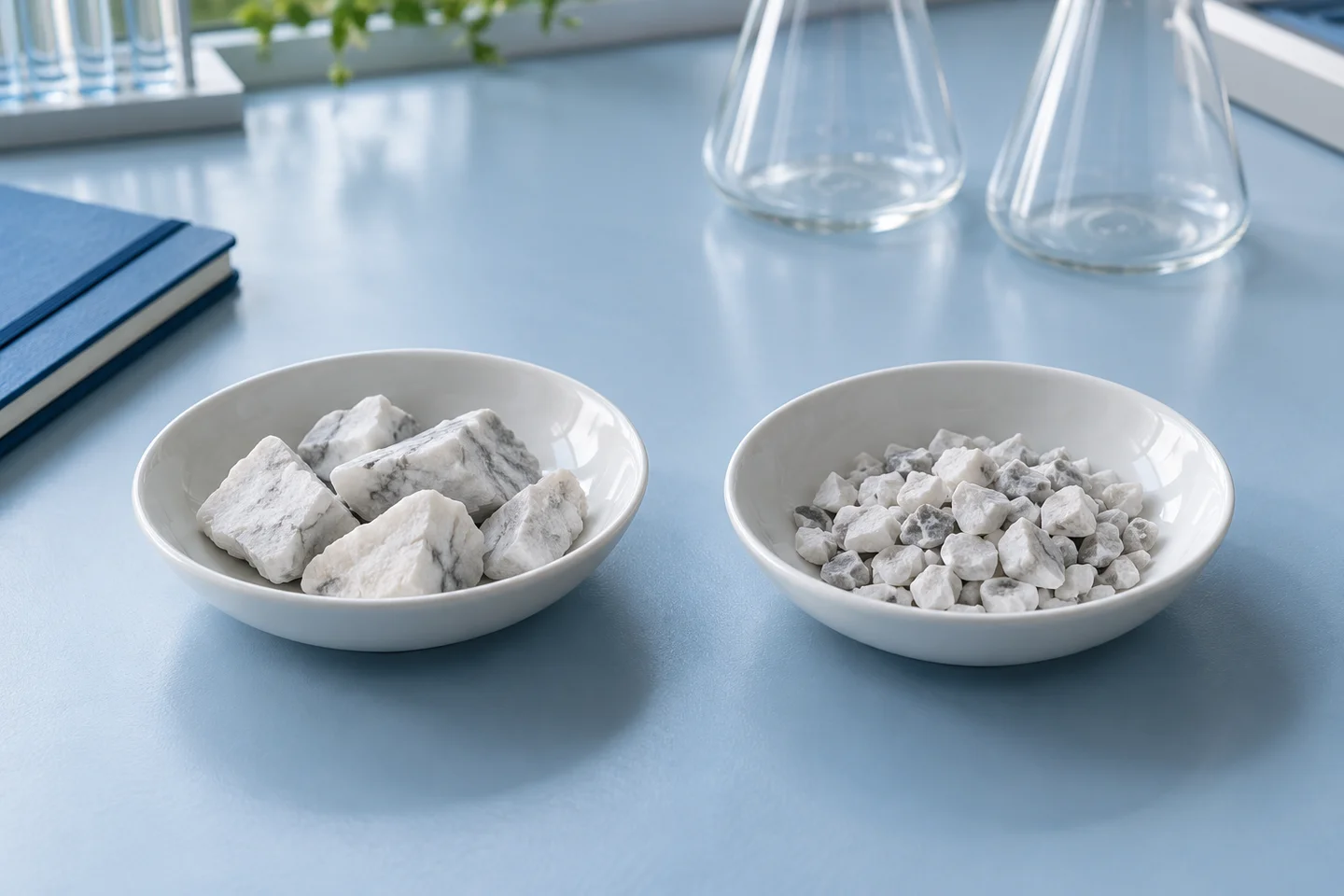
Two experiments use equal masses of pure calcium carbonate. One uses large marble chips and the other uses smaller chips. Each receives the same volume and concentration of excess hydrochloric acid at the same temperature. Explain why the smaller chips react faster initially.
A short response might say: The smaller chips react faster because they are smaller.
This repeats the observation without providing the mechanism.
A more developed response would say:
For the same mass, the smaller chips have a greater total exposed surface area. More of the calcium carbonate is in contact with the acid, so reactive collisions at its surface occur more frequently. This increases the initial rate of carbon dioxide production.
The improvement comes from the causal link: smaller pieces → greater exposed area → more frequent reactive collisions → faster initial reaction.
A useful follow-up is: Will the smaller chips produce more carbon dioxide by the end? With equal masses of pure calcium carbonate, excess acid and complete reaction, both experiments produce the same amount of carbon dioxide. Chip size changes how quickly the reaction proceeds, not the amount of calcium carbonate available.
This follow-up exposes a common confusion between reaction rate and total product. It also gives a teacher a specific next step: ask the student to distinguish “more gas each second” from “more gas altogether”.
Explore the related Grade 10 Kinetics and Thermochemistry Criterion A assessment for topic assessment and revision.
Biology example: using data to evaluate a claim
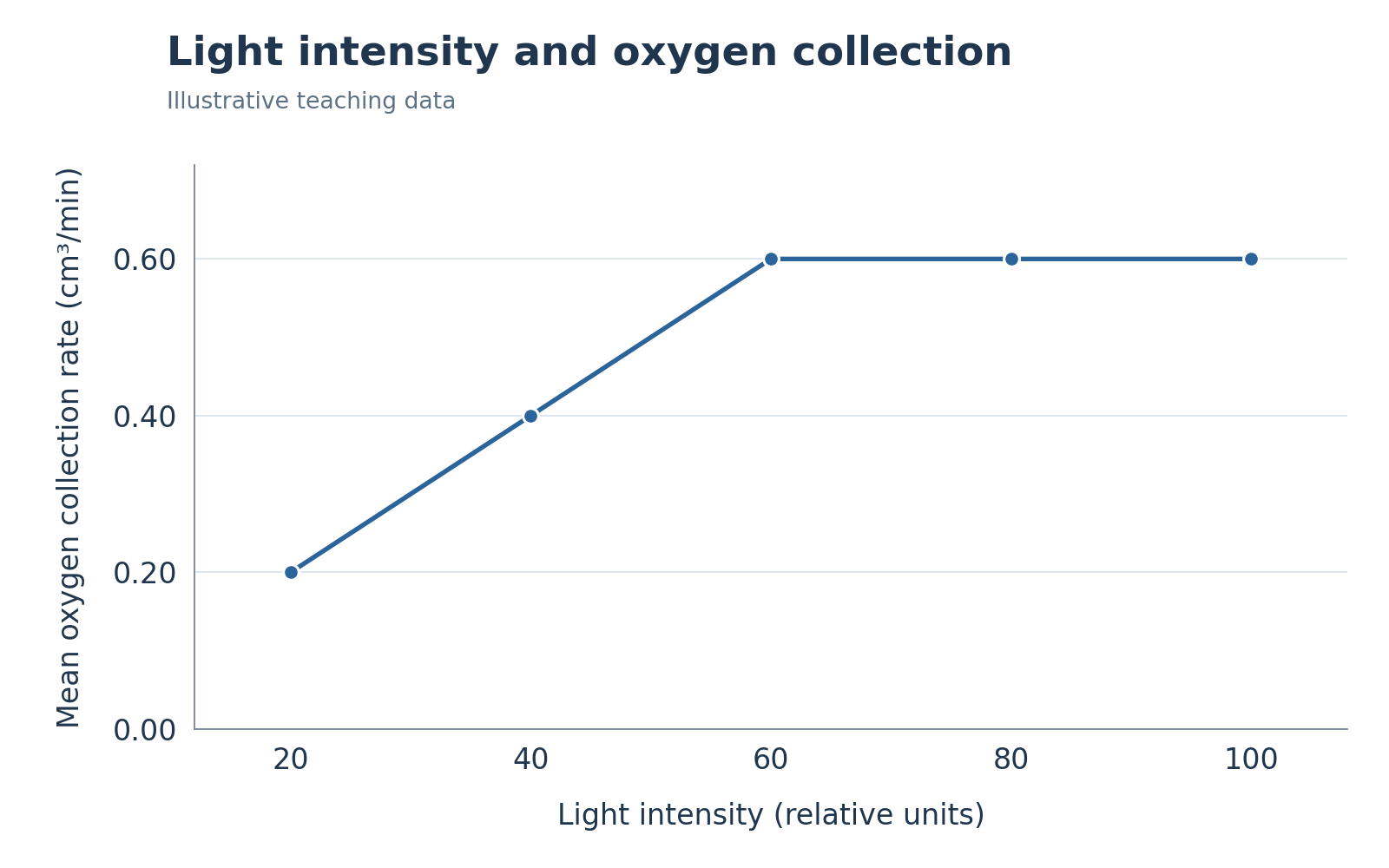
Give students a small dataset with a clear change in the pattern. The following illustrative teaching data show mean oxygen collection rates for the same pondweed setup at different light intensities. Temperature and the supplied carbon dioxide concentration are kept constant. The values are constructed for this activity, not reported experimental findings.
| Light intensity (relative units) | Mean oxygen collection rate (cm³/min) |
|---|---|
| 20 | 0.20 |
| 40 | 0.40 |
| 60 | 0.60 |
| 80 | 0.60 |
| 100 | 0.60 |
Try this question
A student claims that increasing light intensity always increases the rate of photosynthesis. Evaluate this claim using the data and your scientific understanding.
Explained response
The claim is only supported over part of the measured range. As light intensity increases from 20 to 60 relative units, mean oxygen collection rises from 0.20 to 0.60 cm³/min. Between 60 and 100 units, it remains at 0.60 cm³/min.
Light supplies energy for photosynthesis. Increasing its availability can increase the rate when light is limiting. The plateau is consistent with light no longer being the limiting factor under these conditions. Another factor, such as carbon dioxide availability or the capacity of the photosynthetic machinery, may constrain the rate.
The data do not establish which factor causes the plateau. They also do not justify a claim about every plant or all light intensities. Oxygen collection is an indicator of photosynthetic activity under the stated conditions, and collection losses or respiration can affect what is measured.
A useful response therefore includes three things: a judgment about the claim, numerical evidence and a scientific explanation. This is a writing scaffold for the activity, not a formula for an achievement level.
For feedback, underline the evidence in one colour and the scientific explanation in another. A response with only a trend needs a mechanism; a response with only a mechanism needs reference to the supplied results.
For further topic practice, view our Grade 10 Plant Biology Criterion A assessment.
How should teachers use marks and Criterion A levels?
A raw total shows the marks earned on a particular paper. A Criterion A achievement level, up to 8, is judged against its descriptors using a best-fit approach. A percentage alone is not a universal IB conversion to that level. Refer to the assessment guidance in the Sciences guide and your school’s current guidance.
For the examples in this article, use the responses to identify the next teaching step. Do not label one correct calculation or one developed paragraph as an automatic level 7 or 8.
- Correct calculation, little reasoning: ask the student to explain the relationship before changing a variable.
- Correct terminology, weak explanation: ask how one step causes the next.
- Claim without evidence: ask for two relevant values and the conclusion they support.
A 15-minute routine for preparing students
Use one short question before the full assessment. Here is a routine to try:
- Minutes 0–3: Students answer independently, without notes.
- Minutes 3–6: In pairs, they compare methods and identify one difference in reasoning.
- Minutes 6–9: Show an explained response. Ask students to locate the evidence or causal link they missed.
- Minutes 9–12: Change one feature of the problem, such as mass, chip size or a data value. Students revise their answers.
- Minutes 12–15: Collect a one-sentence exit response explaining the change.
Read the exit responses before planning the next lesson. If many students can calculate but cannot explain, model a causal explanation. If they explain the theory but ignore the data, practise selecting evidence. Keep revision focused on the difficulty their work reveals.
Common questions about Criterion A assessments
Is Criterion A only about memorising facts?
No. Accurate recall helps, but students also need opportunities to use concepts, explain outcomes and examine a claim. Try changing a familiar question slightly to see whether the reasoning still holds.
Can a Criterion A assessment include multiple-choice questions?
Yes. Use them to check understanding and uncover misconceptions. For a fuller picture of a student’s reasoning, include opportunities to explain a choice, show working or justify a conclusion.
Does using a graph automatically make a question Criterion C?
No. In these examples, the graph supplies information for judging a scientific claim. Map the task to the strand it assesses; the presence of a graph alone does not decide the criterion.
How much should students write?
The task determines the detail needed. A calculation needs clear working and units when requested; an explanation needs a mechanism; a judgment needs evidence and reasoning. Extra length is useful only when it adds relevant information.
Find Grade 10 MYP science assessments for your next unit
The Science Shop offers individual Criterion A assessments and larger subject bundles across biology, chemistry and physics. The resource pages show the topics, included files and available previews so you can check the fit for your class.
- Grade 10 Biology Criterion A assessments bundle
- Grade 10 Chemistry Criterion A assessments bundle
- Grade 10 Physics Criterion A assessments bundle
Choose an individual topic when you need one assessment, or review the bundle if you are planning across several units. Use the sample pages to check the question style and level before purchasing.