
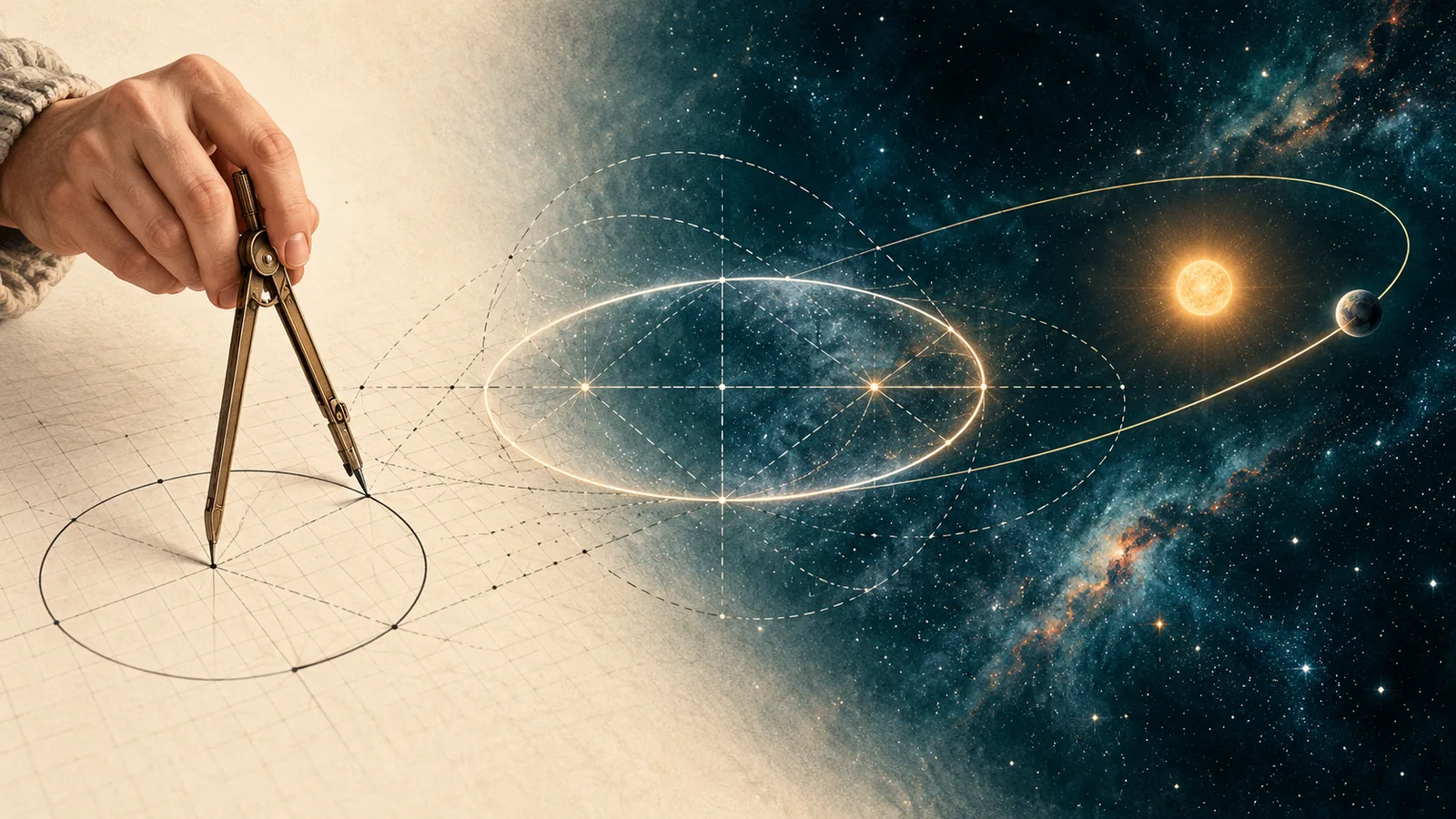
- Teach TOK mathematics by asking whether mathematics is invented or discovered, then have students test their answers through examples, debate and a card sort.
- This IB TOK mathematics lesson plan takes 60 minutes and needs no advanced calculations: students compare four philosophical positions and examine how mathematics describes the world.
- Finish with a short written judgement that uses an example, answers an objection and identifies what remains uncertain.
A student can use pi correctly without ever asking what kind of thing pi is. That gap gives Theory of Knowledge (TOK) teachers a useful starting point. The lesson below turns a familiar mathematical idea into a question about existence, evidence and justification.
It follows the six-stage sequence in The Science Shop’s Is Mathematics Invented or Discovered lesson walkthrough. You can teach the sequence from this article or use the editable walkthrough and activity sheets to prepare.
Your 60 minute IB TOK mathematics lesson plan
Audience: IB Diploma Programme Year 1 or Year 2. Area of knowledge: mathematics. Central question: Is mathematics invented or discovered?
By the end, students should be able to distinguish mathematical notation from mathematical relationships, explain contrasting views and defend a judgement while recognising a serious objection.
Prepare: a board or shared slide, a timer, four position cards, one set of the 12 sorting cards per group and paper for an exit ticket. Use the descriptions below to make your own cards. Students only need familiar ideas such as circles, whole numbers and equality; briefly explain any unfamiliar card.
| Time | Activity | What students produce |
|---|---|---|
| 0–8 minutes | The pi provocation | A first position and a reason |
| 8–18 minutes | Four philosophical positions | A private choice and a question |
| 18–32 minutes | A structured team debate | An argument that answers an objection |
| 32–44 minutes | Three links between maths and nature | A judgement about what each case shows |
| 44–54 minutes | A 12-card sort and the alien test | A justified classification |
| 54–60 minutes | Knowledge questions and exit ticket | A qualified written conclusion |
The aim is to make students’ reasoning visible. Keep asking: “What is your reason?” “Which example supports it?” and “What would make you reconsider?”
Teach the lesson in six phases
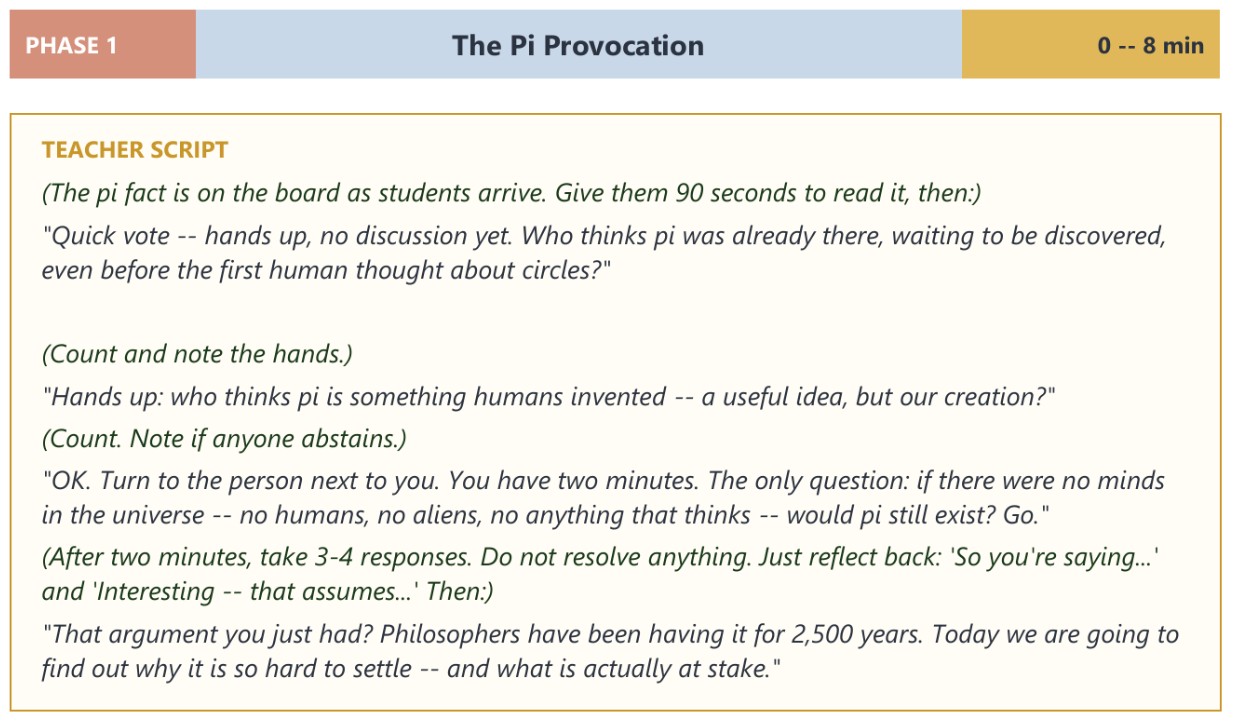
1 The pi provocation from 0 to 8 minutes
Write this question on the board:
If no minds existed anywhere in the universe, would pi still exist?
Allow a minute of silent thinking. Take a quick vote: yes, no or unsure. Record the tally without announcing a correct answer.
Next, give pairs two minutes to explain their choices. Bring the class back together and draw a circle. In Euclidean geometry, pi is the constant ratio of an ideal circle’s circumference to its diameter. Ask: “Did people invent the symbol, the relationship, or both?”
Listen for the distinction: a human choice of notation does not by itself settle whether the relationship exists independently of us. Equally, agreement about a relationship does not prove that numbers inhabit a separate realm.
If students mention pi’s digits, clarify the mathematics: pi is irrational, so its decimal expansion never ends and never settles into a repeating block of digits. That is different from saying its digits have “no pattern” of any kind. The philosophical question does not depend on the latest calculation record.
2 Introduce four positions from 8 to 18 minutes
Give each position about a minute. These are entry points into a larger debate; philosophers within each tradition disagree. Use the Stanford Encyclopedia of Philosophy’s overview for further background.
- Platonism: mathematical objects exist independently of human thought, and mathematical work discovers truths about them. Challenge: how could people gain knowledge of non-physical objects?
- Formalism: some versions treat mathematics as working with symbols under specified rules. People choose a system, then investigate what follows within it. Challenge: how does this explain meaning and the usefulness of mathematics? David Hilbert is associated with an influential formalist programme; formalism is more varied than the slogan “just a game” suggests. See the overview of formalism.
- Intuitionism: associated with L. E. J. Brouwer, this view grounds mathematics in mental construction. It does not accept every classical proof method without qualification. Challenge: what changes when an existence claim needs a construction rather than a purely indirect argument?
- Fictionalism: mathematical language can be useful without committing us to the existence of abstract numbers. Hartry Field developed an influential version. Challenge: how can mathematics contribute so successfully to science? See the overview of mathematical fictionalism.
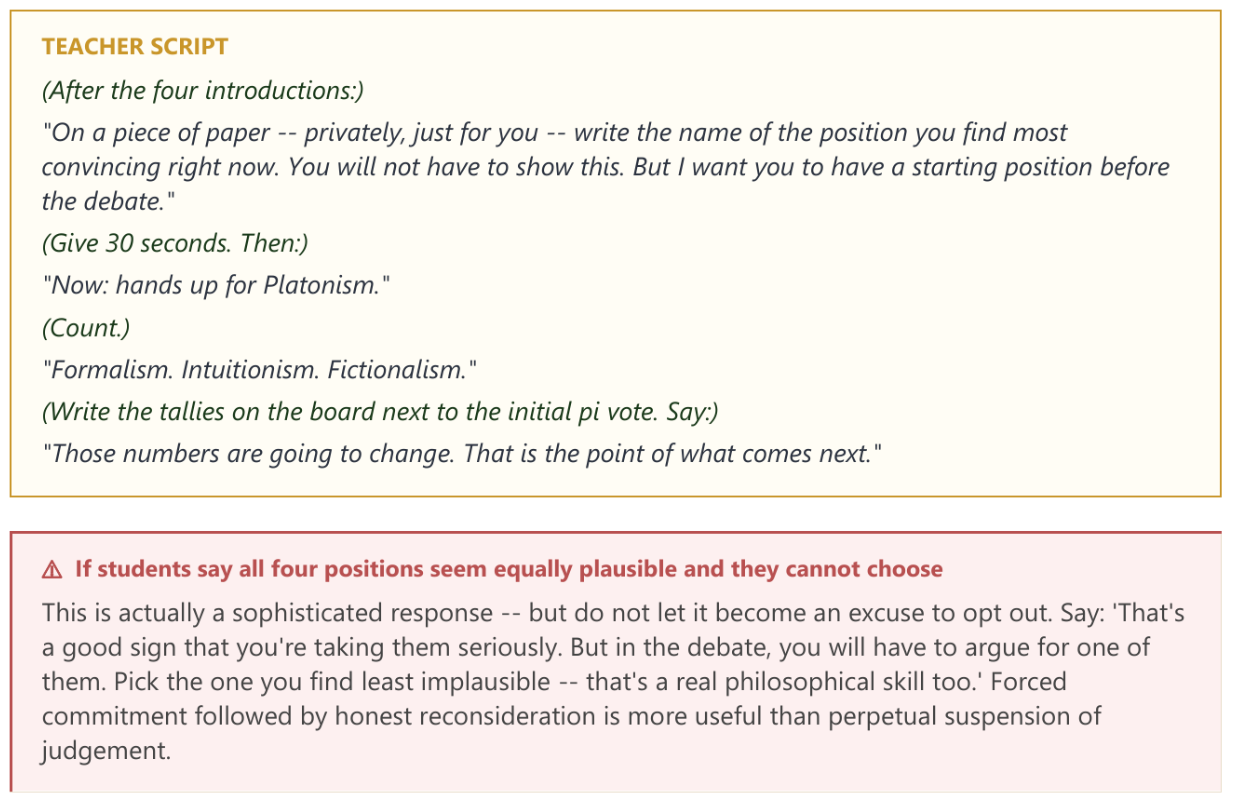
Use the remaining time for pairs to restate one position in their own words. Then ask students to record their preferred view privately, with one reason and one doubt. This gives quieter students something to contribute before the debate begins.
3 Run a structured debate from 18 to 32 minutes
Assign four teams, one per position. Students may defend a view they do not personally hold. Give every team this preparation frame:
- Our position is…
- A mathematical example that supports it is…
- The strongest objection we expect is…
- Our response is…
Keep to 14 minutes: five minutes to prepare; 90 seconds for each of the four teams; two minutes for brief challenges and responses; one minute for a fresh private vote.
If you use points, award 1–3 for a clear claim, 1–3 for a relevant reason and 1–3 for addressing an objection. Add one bonus point for a well-explained example. This is a classroom participation tool, not an IB assessment rubric.
Ask students to explain any change of mind. Staying with a view can also be thoughtful if they can explain why it survived the challenge. Reward the quality of reasoning rather than a team’s popularity or speaking confidence.
4 Examine three connections with nature from 32 to 44 minutes
Physicist Eugene Wigner explored the surprising usefulness of mathematics in his 1960 essay on mathematics in the natural sciences. Use the following cases to test the competing explanations. Allow about three minutes per case and three minutes to compare conclusions.
- Ellipses and planetary orbits. Mathematicians studied ellipses long before Kepler used them to describe planetary motion. NASA’s explanation of Kepler’s laws gives a useful visual context. Elliptical orbits are an idealisation; interactions with other bodies can perturb them. Ask: “Does a mathematical shape fitting an observed orbit support discovery?”
- Complex numbers and quantum mechanics. Complex numbers combine real numbers with an imaginary component, using i, where i² = −1. They became central to standard mathematical formulations of quantum mechanics. Ask: “Does the success of a mathematical tool tell us that its objects physically exist?”
- Geometry and general relativity. The development of geometries beyond Euclid, including Riemann’s work on curved spaces, supplied tools later used in general relativity. Ask: “If several mathematical geometries are available, how do we decide which helps describe the physical world?”
After each example, invite an explanation from each side: perhaps mathematics reveals a structure that was already there; perhaps people develop many systems and select those that model observations well. A useful model may have a limited domain of accuracy. These cases raise the debate; they do not settle it.
5 Use the card sort and alien test from 44 to 54 minutes
Put students in small groups. Give them these 12 cards and three headings: Invented, Discovered and Genuinely unclear.
- Zero: a number, a concept of absence, or the written symbol 0?
- Pi: the ratio for ideal Euclidean circles.
- The equals sign: the written symbol =.
- Prime numbers: whole numbers greater than 1 with exactly two positive divisors.
- Imaginary numbers: numbers such as i, with i² = −1.
- Infinity: an idea that takes different forms in mathematics.
- The Pythagorean theorem: a relationship for right-angled triangles in Euclidean geometry.
- Euclidean geometry: a mathematical system with particular assumptions.
- The Mandelbrot set: a set defined through repeated complex-number calculations.
- Calculus: methods for studying change and accumulation.
- The number line: a way of representing numbers spatially.
- Mathematical proof: justification through accepted rules of reasoning.
Allow five minutes to sort, two minutes to discuss the hardest card and three minutes to share. Require a written reason for at least one placement. Groups may split a card into “symbol” and “relationship” if they explain why.
The alien test: “Would a civilisation with no contact with humans develop the same mathematics?” The equals sign could look different. If aliens used the same natural-number structure, 17 would still have exactly two positive divisors. But we do not know how aliens would think, and this thought experiment cannot prove that mathematical objects exist independently.
A useful follow-up is: “What exactly are you classifying?” A group might call a notation invented while treating the consequences of a definition as discovered. The “unclear” column should contain a reasoned difficulty, not an unexplained shrug.
6 Finish with a written judgement from 54 to 60 minutes
Spend two minutes drawing out a knowledge question, then give students four minutes to write. Offer this three-part frame:
- Mathematics is [invented, discovered, both or neither] because… For example…
- The strongest objection to my view is…
- My response is… This leaves open the question of…

An illustrative response: “Mathematics involves both invention and discovery. We choose notation and definitions, yet the consequences can surprise us. For example, choosing a symbol for equality does not let us choose whether 17 is prime under the usual definition. An objection is that this only shows consistency within human rules. I therefore need to distinguish discovering a consequence from proving that numbers exist independently.”
Read the tickets for a clear distinction, a relevant example and an objection genuinely answered. Use the most common unresolved issue to open the next lesson.
TOK mathematics knowledge questions to take further
Move from a particular number or object to questions about how knowledge is produced and justified:
- To what extent do the methods of mathematics support the view that mathematical knowledge is discovered?
- How do definitions and axioms shape what counts as mathematical knowledge?
- What does the success of a mathematical model tell us about its truth?
- How does mathematical proof differ from evidence in the natural sciences?
These are teacher-created discussion questions, not current IB prescribed essay titles. For a further lesson on intuition, elegance and proof, explore the Mathematics Beauty and Intuition walkthrough.
Connect the lesson to the TOK essay and exhibition
The IB assesses TOK through an exhibition and a 1,600-word essay. This lesson practises useful thinking, but an exit-ticket formula is not a complete assessment method.
For the TOK essay
Ask students to develop one example into a paragraph that explains a claim, considers a different view and explores an implication. For assessed work, they must respond to one of the six titles issued for their examination session. The IB changes those titles each session, so check the current set before making a specific essay link.
For the TOK exhibition
The exhibition uses three specific objects linked to the same official IA prompt, with a maximum of 950 words across the commentaries. Each object needs a real-world context and a clear justification for its contribution. Follow the IB TOK guide and current school guidance.
Possible starting points include a particular historical page showing mathematical notation, a calculator the student actually uses or a specific published mathematical visualisation. Establish where each object comes from, what it was used for and why it illuminates the chosen prompt. A generic picture of pi or an image created solely to illustrate an abstract idea is not automatically a suitable exhibition object.
Adapt the lesson for your class
- For hesitant speakers: keep the first response private, assign roles such as example-finder and objection-checker, and let a pair read a jointly written argument.
- For students unfamiliar with the maths: demonstrate a circle, equality and prime numbers first. Offer short definitions for the other cards without making the lesson a calculation test.
- For greater challenge: compare Euclidean and non-Euclidean geometry. Ask whether certainty within an axiomatic system is the same as knowing which system describes physical space.
- For a 45-minute period: use 5 minutes for the hook, 7 for positions, 10 for debate, 8 for two application examples, 9 for six cards and 6 for the exit ticket. Move the remaining examples and cards to the next lesson.
Frequently asked questions about TOK mathematics lessons
Do students need advanced mathematics for this lesson?
No. The core discussion uses circles, equality and whole numbers. Explain unfamiliar terms briefly and assess how students justify their thinking rather than their speed at calculation.
Is mathematics invented or discovered?
There is no universally accepted philosophical answer. Some views emphasise mind-independent objects; others emphasise formal systems, mental construction or useful mathematical language. Students can distinguish invented notation from consequences that follow within a system while recognising that the question of independent existence remains open.
What makes this a TOK lesson rather than a maths lesson?
The focus is how mathematical knowledge is produced, justified and applied. Students use mathematical examples to examine those questions, rather than practising a calculation procedure as the main goal.
Can students use the examples in assessed TOK work?
Potentially, if an example genuinely helps answer their selected essay title or exhibition prompt. They must research it accurately, explain its relevance and follow current IB requirements. A classroom activity is a starting point for their own analysis.
Get the editable lesson resources
The Is Mathematics Invented or Discovered lesson pack includes two editable Word files: a 17-page teacher walkthrough and 7 pages of activity sheets. The walkthrough provides preparation guidance, classroom prompts and the planned 60-minute sequence. Pagination may vary with fonts and software.
For wider course planning, the TOK 44-Lesson Collection brings together lessons across TOK topics, including this mathematics lesson. Check the contents against resources you already own.
Start with the question about pi, record students’ first reasons and return to them at the end. The most useful outcome is a more precise account of what students believe and why.