
Most middle years science units on mass and weight start, and quickly end, with the same routine. We define the terms, write W = mg on the board, and hand out a worksheet filled with sample calculations. Students plug in the numbers, calculate weight in newtons from mass in kilograms, and move on to the next topic without truly grasping the fundamental difference between the amount of matter in an object and the gravitational force acting upon it.
If we want students to internalise why a 10 kg bag of flour behaves differently on Earth than it does on the Moon, we need to push the concept further than rote arithmetic. For educators navigating middle school or building foundational skills for upper-level science programmes like the IB Diploma, applied, scenario-based problem solving can give this abstract physics concept a practical context.
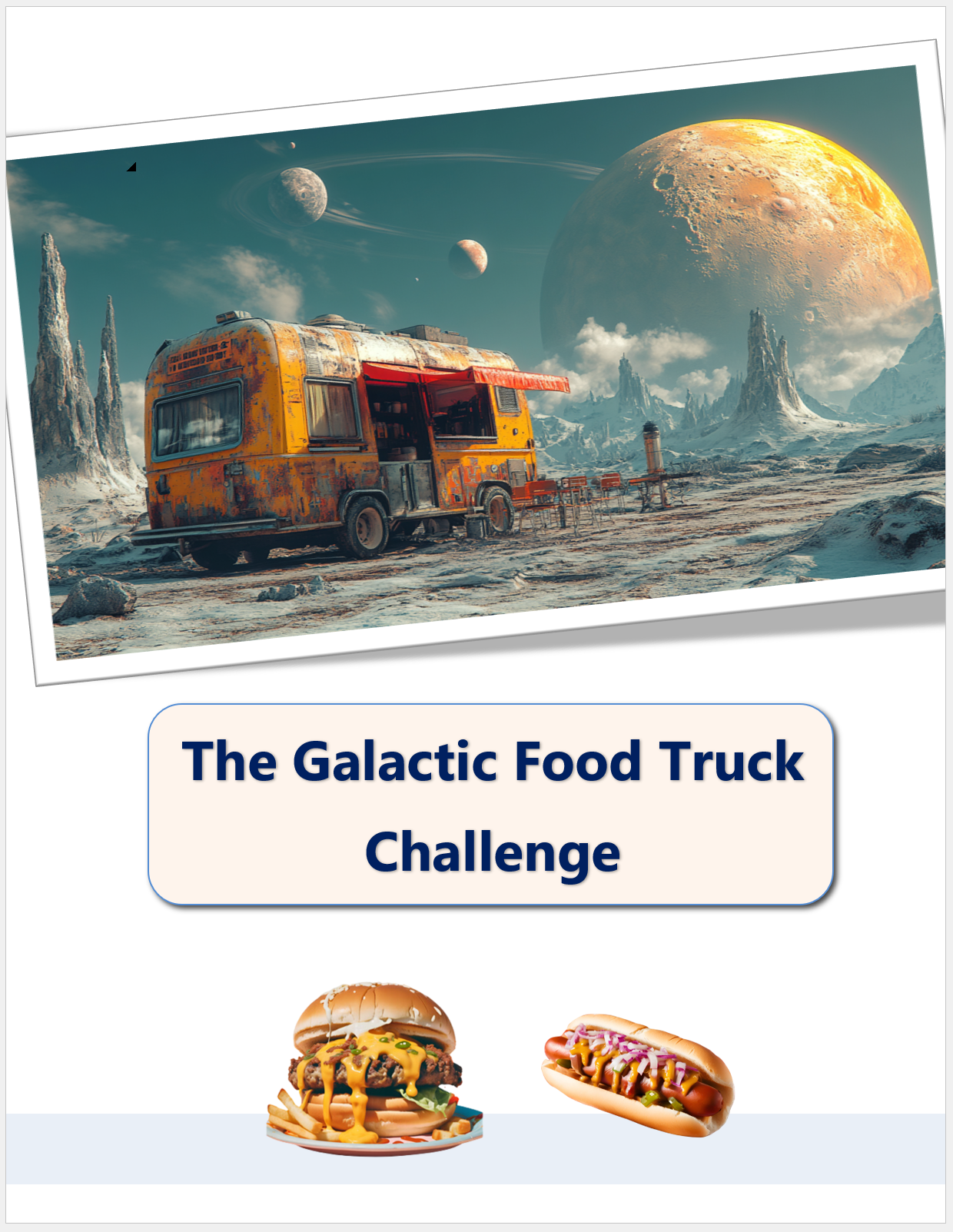
Enter the Galactic Food Truck Challenge.
Moving Beyond the Formula
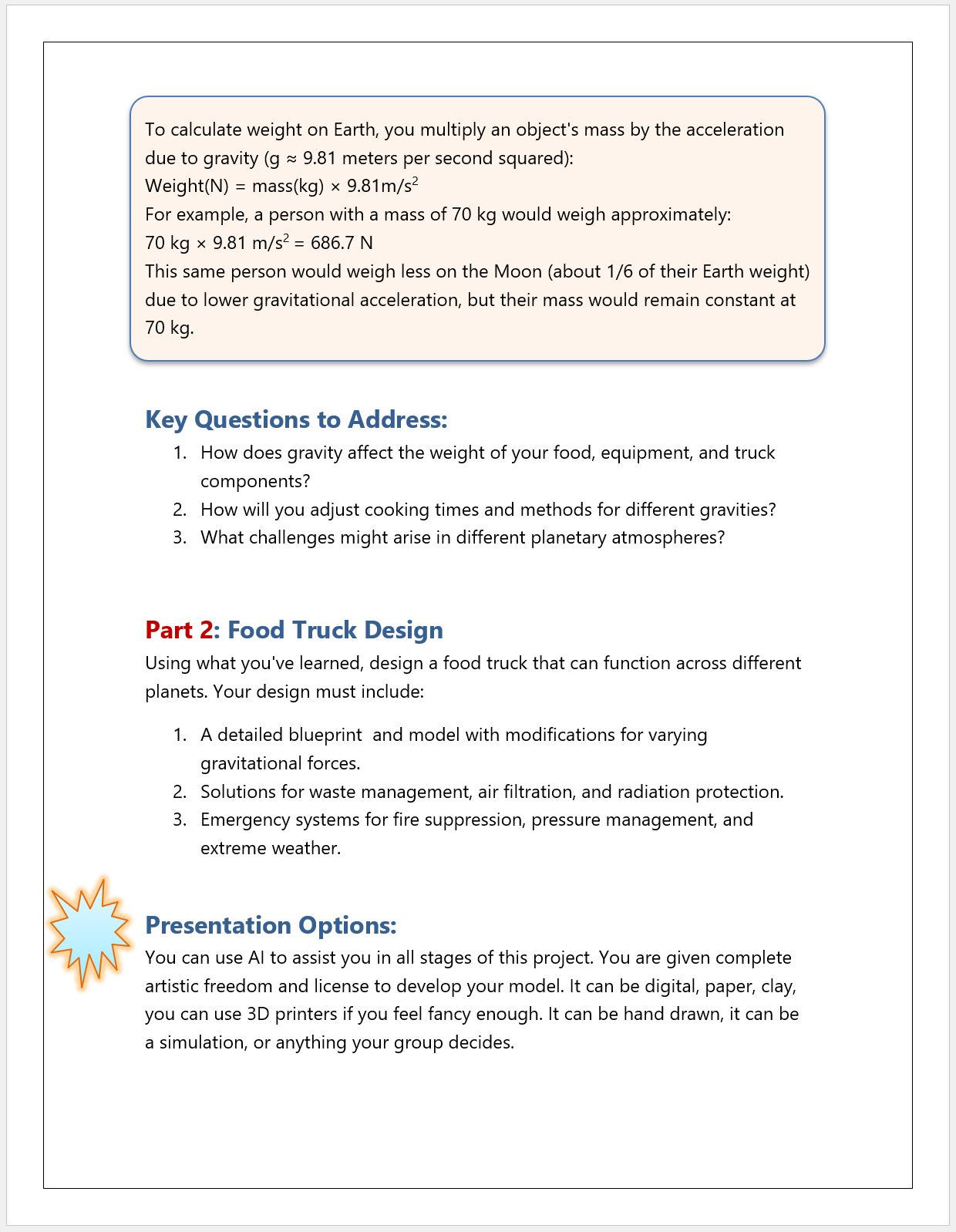
The premise of the food truck challenge is simple but highly engaging. Students are tasked with designing and operating a food truck that travels to different planets or celestial bodies. To succeed, they cannot just memorise a formula; they have to apply it to logistical business problems.
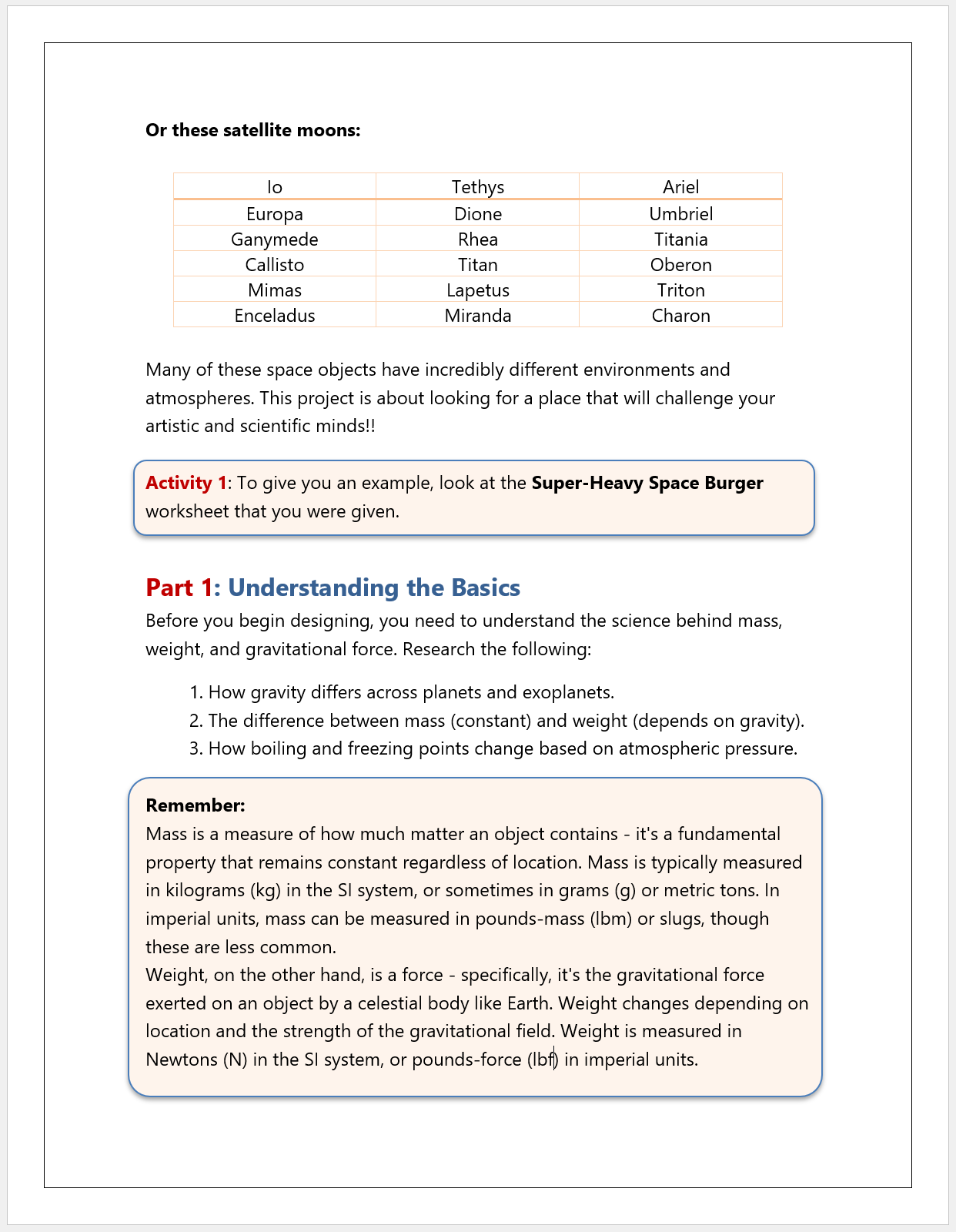
Activity 1 introduces the challenge and sets the stage by asking students to confront immediate hurdles. For instance, the mass of their food truck’s ingredients remains constant no matter where they park, but the weight changes with the local gravitational field strength. That affects the load on the truck’s suspension and the thrust needed to lift it.
In W = mg, W is weight in newtons (N), m is mass in kilograms (kg), and g is gravitational field strength in newtons per kilogram (N/kg). Changing location changes g, not the mass of the ingredients.
Why This Approach Works
- Conceptual Anchoring: In a hypothetical comparison at the same price per newton, buying 50 N of potatoes in Jupiter’s stronger gravitational field gives students less potato mass than buying 50 N on Mars. They have to rely on mass, measured in kilograms, as the consistent measure of their inventory. Jupiter is a gas giant, so this is a calculation scenario, not a suggestion that a truck could park on a solid surface there.
- Cross-Curricular Engagement: The activity blends foundational physics with entrepreneurship and critical thinking, pushing students to defend their operational choices using scientific reasoning.
- Purposeful Repetition: Instead of filling out 20 identical worksheet questions, students repeatedly use W = mg to solve evolving problems within the simulation.
Bringing the Challenge to Your Classroom
Transitioning from traditional worksheets to an immersive project does not require sacrificing academic rigour. By framing standard calculations within a concrete scenario, students can practise the mathematics while developing a deeper understanding of Newtonian physics.
If you are ready to move beyond standard conversion handouts and bring this physics scenario to your students, the complete lesson framework and challenge materials are available in the shop to help you launch your own classroom food truck fleet.
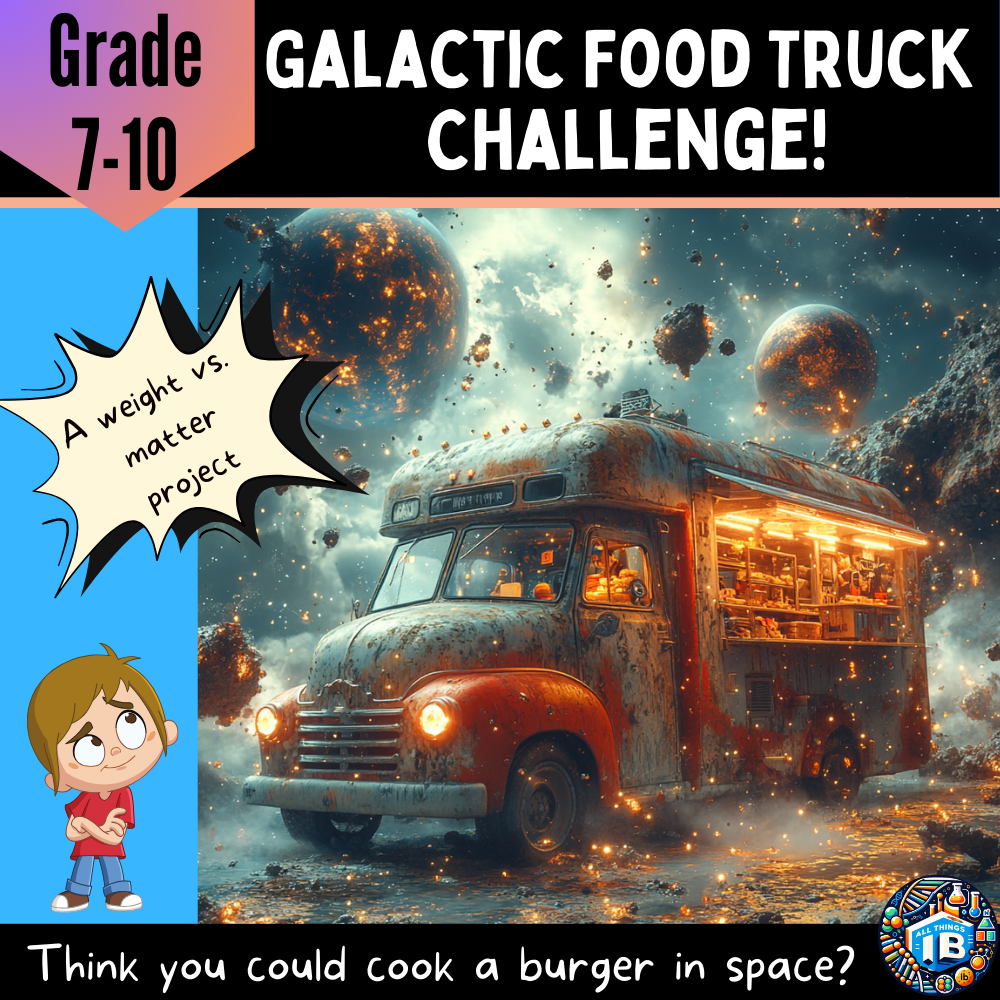
Bring the Galactic Food Truck Challenge to your classroom
Explore the resource details and sample pages before choosing it for your class.