
Follow carbon fixation, reduction and regeneration in the chloroplast stroma. Carbon totals and the ATP/NADPH budget help students see why the cycle must regenerate its starting acceptor.
Choose from five images below. Open an image for a closer look, download its original PNG, or download all five as a ZIP.
Use these visuals in your lesson
Count carbons before naming every intermediate. Use the net-product view to distinguish molecules that leave the cycle from those used to regenerate RuBP.
A question to discuss
Why do most of the triose phosphates remain in the cycle rather than leaving it?
Calvin cycle: five teaching visuals

Three phases
Fixation, reduction and regeneration in the chloroplast stroma.
Download original PNG
Molecules in motion
Three CO2 enter the cycle and one G3P is the net carbon product.
Download original PNG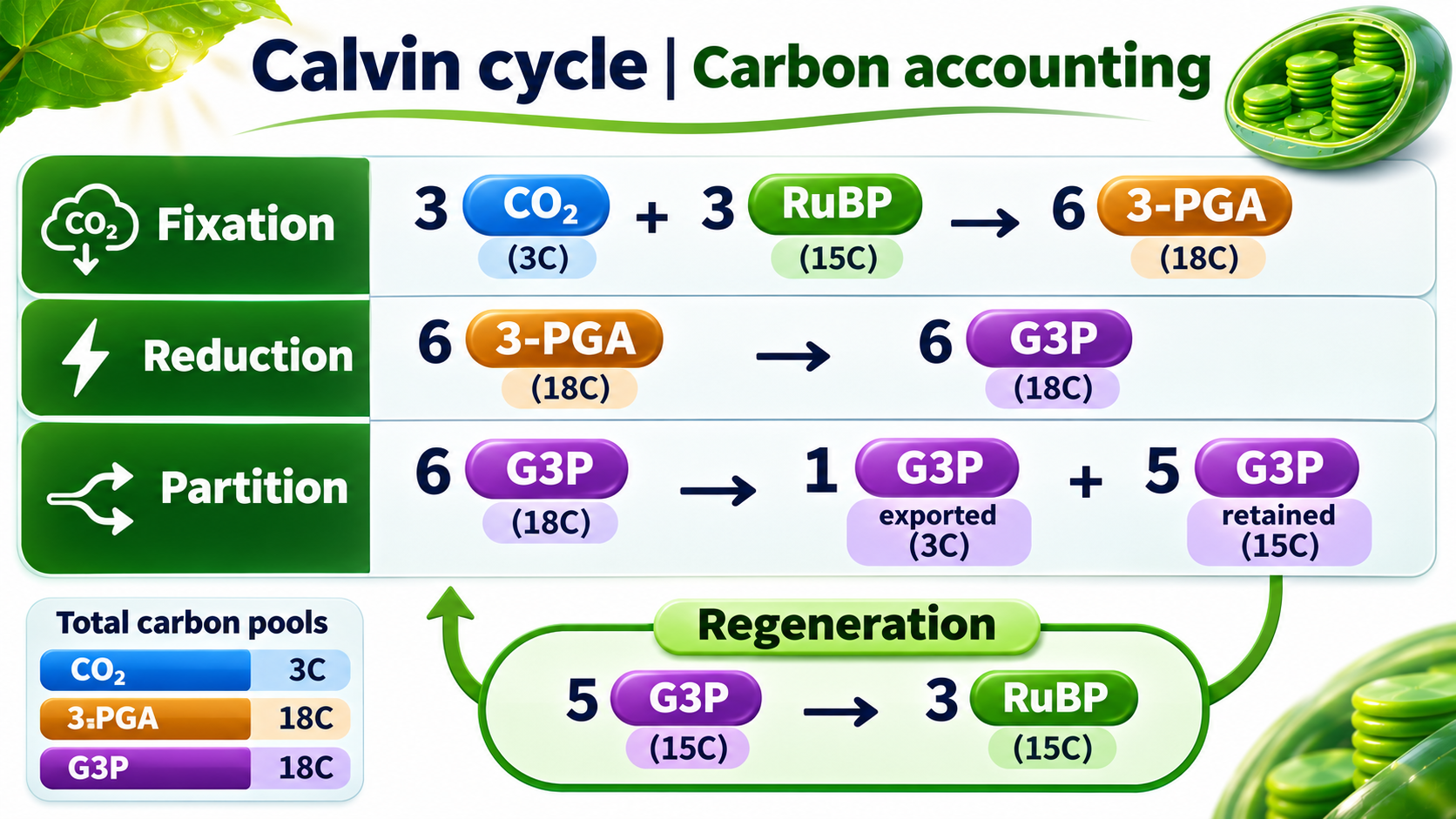
Carbon accounting
Track carbon totals through fixation, G3P partition and RuBP regeneration.
Download original PNG
The energy budget
One net G3P from three CO2 requires nine ATP and six NADPH.
Download original PNG
Using the carbon
Triose phosphates support starch synthesis in the chloroplast and sucrose synthesis in the cytosol.
Download original PNG