
Addition polymerisation joins alkene monomers into chains. A repeat unit describes part of that chain, so its backbone bonds continue through the brackets.
Choose from five images below. Open an image for a closer look, download its original PNG, or download all five as a ZIP.
Use these visuals in your lesson
Ask students to retain every substituent when converting a monomer into its repeat unit.
A question to discuss
Why is a bracketed repeat unit not an isolated molecule?
Addition polymerization: five teaching visuals

Ethene becomes polyethene
Ethene becomes polyethene
An ethene monomer equation produces a bracketed two-carbon polyethene repeat unit.
Download original PNG
Reading repeat-unit brackets
Reading repeat-unit brackets
The polyethene backbone extends through the brackets; each carbon retains four bonds.
Download original PNG
Monomer, repeat unit and chain
Monomer, repeat unit and chain
Three representations distinguish ethene, a polyethene repeat unit and a short continuing chain segment.
Download original PNG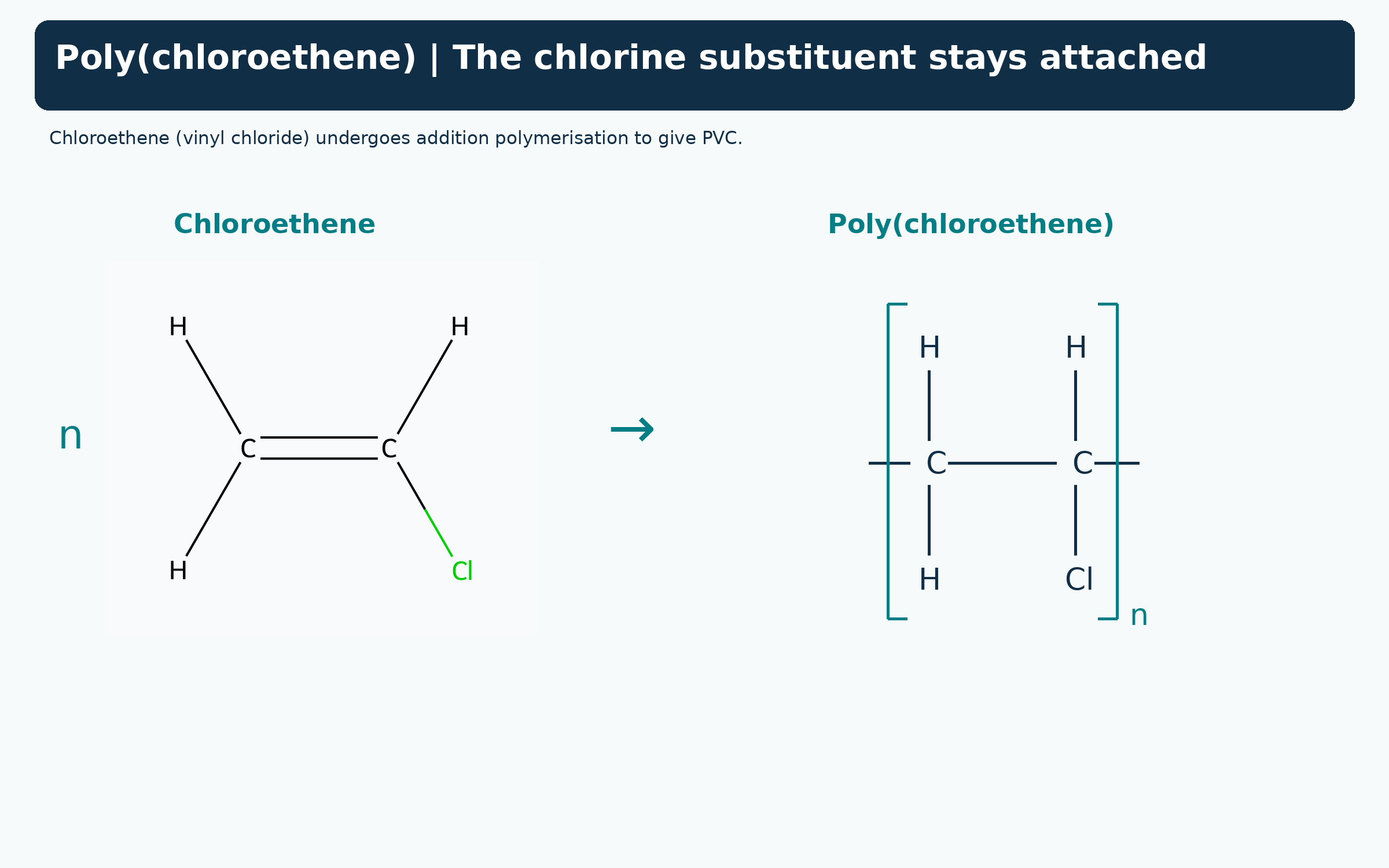
Chloroethene becomes PVC
Chloroethene becomes PVC
The chlorine substituent remains attached when chloroethene forms poly(chloroethene).
Download original PNG
A finite hydrogen-terminated fragment
A finite hydrogen-terminated fragment
An MMFF-optimised extended decane model illustrates H–(CH2CH2)5–H, not a bulk polymer sample.
Download original PNGAbout these representations
Repeat-unit drawings preserve carbon valence; level 5 is an MMFF-optimised finite C10H22 fragment, not bulk polyethene.