
Connect qualitative atomic-radius trends with occupied shells, nuclear attraction and definitions of radius.
Choose from five images below. Open an image for a closer look, download its original PNG, or download all five as a ZIP.
Use these visuals in your lesson
Compare atoms within one group or period before discussing why radius depends on its definition.
A question to discuss
Why does atomic size generally decrease across Period 3 despite the increasing electron count?
Atomic radius trends: five teaching visuals

Teaching illustration
A periodic pattern
Qualitative sphere sizes show larger atoms down a group and generally smaller atoms across a period.
Download original PNG
Teaching illustration
More occupied shells
Lithium, sodium and potassium shell models illustrate increasing occupied shells down Group 1.
Download original PNG
Teaching illustration
Period 3 size trend
Sodium through chlorine illustrate a qualitative covalent-radius decrease across the period.
Download original PNG
Teaching illustration
The same shell, stronger attraction
Sodium and chlorine shell models compare electron configurations and effective nuclear attraction.
Download original PNG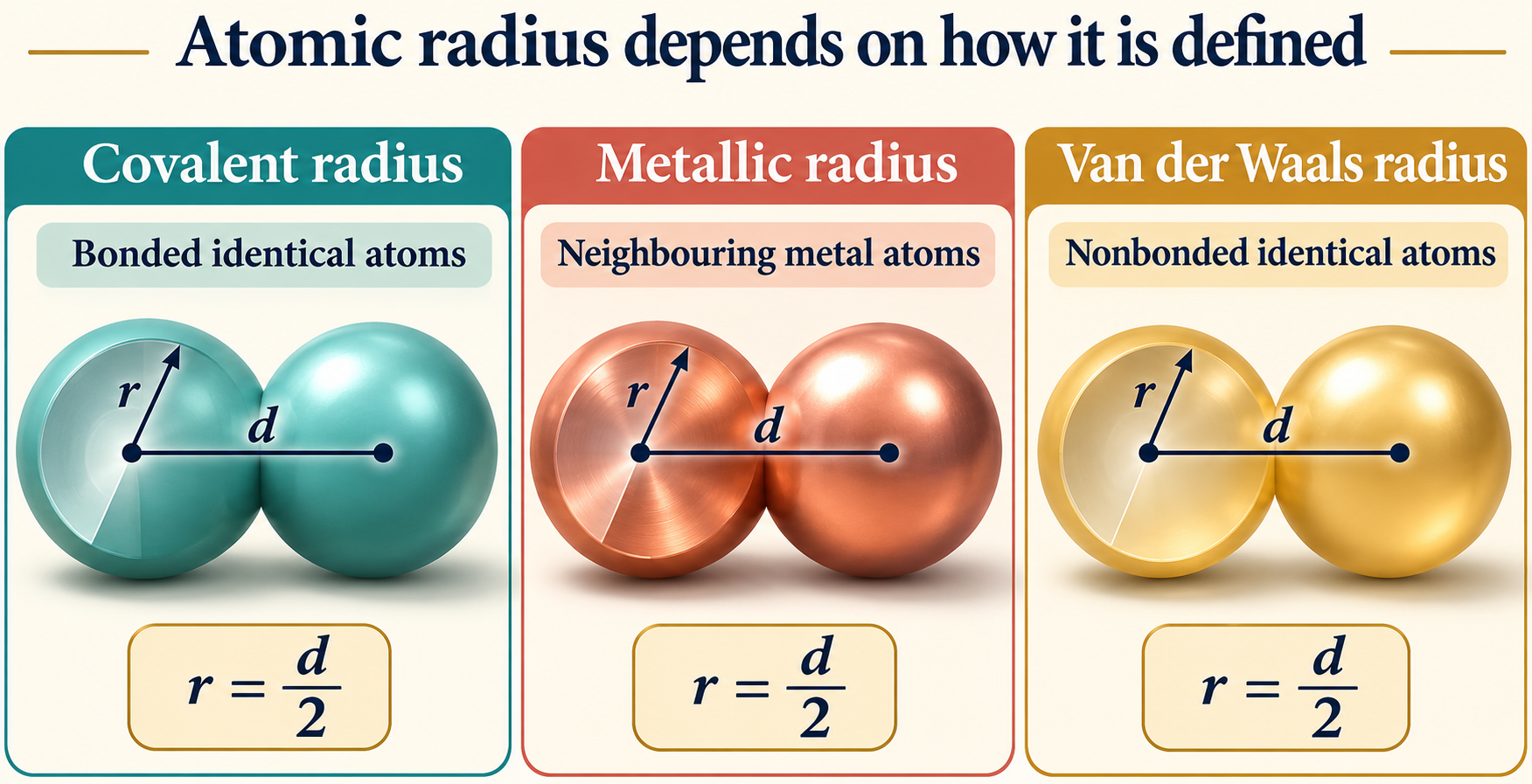
Teaching illustration
Radius depends on its definition
Covalent, metallic and van der Waals radii are each related to half a relevant internuclear distance.
Download original PNGAbout these representations
Qualitative shell and sphere models; relative sizes are explanatory rather than calibrated radii.