
Explain how a weak acid and its conjugate base resist small additions of acid or base.
Choose from five images below. Open an image for a closer look, download its original PNG, or download all five as a ZIP.
Use these visuals in your lesson
Track which buffer component is consumed and which is formed before calculating a pH change.
A question to discuss
Why does a buffer resist pH change without fixing the pH completely?
How a buffer resists pH change: five teaching visuals

Teaching illustration
Inside an acidic buffer
Ethanoic acid and ethanoate are represented as the weak-acid and conjugate-base components.
Download original PNG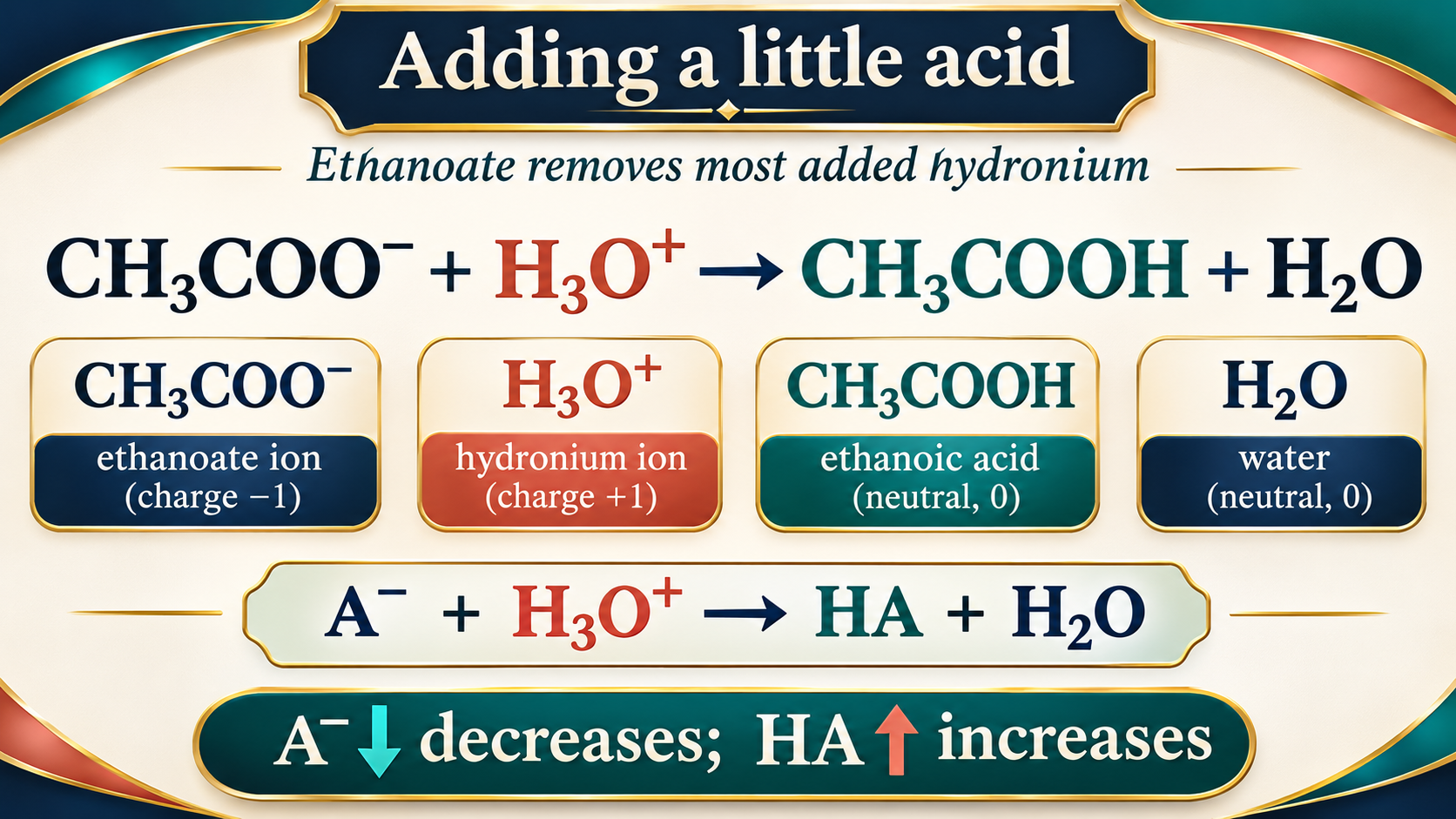
Teaching illustration
Adding acid
Ethanoate reacts with added hydronium, increasing ethanoic acid and reducing conjugate base.
Download original PNG
Teaching illustration
Adding base
Ethanoic acid reacts with hydroxide to form ethanoate and water.
Download original PNG
Teaching illustration
The acid–base ratio
The Henderson–Hasselbalch approximation relates pH to pKa and the conjugate-base/acid concentration ratio.
Download original PNG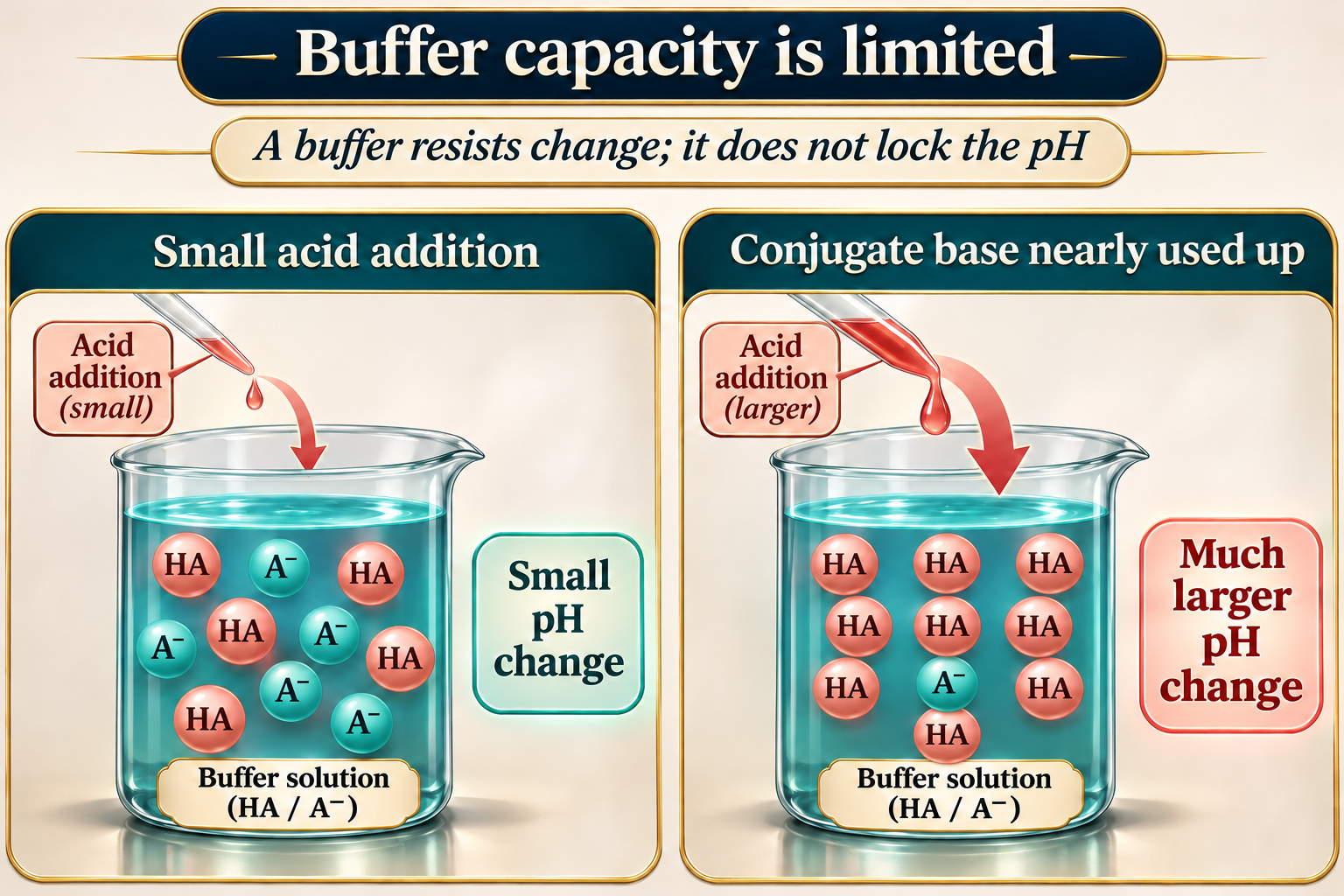
Teaching illustration
Capacity is limited
A comparison shows a small pH change for a small acid addition and a larger change as conjugate base is depleted.
Download original PNGAbout these representations
Symbolic buffer particles omit water and spectator ions. The concentration form of Henderson–Hasselbalch is an approximation for suitable weak-acid buffers.