
Relate diamond, graphite and graphene bonding networks to their properties.
Choose from five images below. Open an image for a closer look, download its original PNG, or download all five as a ZIP.
Use these visuals in your lesson
Compare the number and arrangement of neighbours before connecting bonding with hardness and electrical behaviour.
A question to discuss
Why can graphite conduct within its sheets while diamond is an electrical insulator?
Diamond, graphite and graphene: five teaching visuals
Idealised model
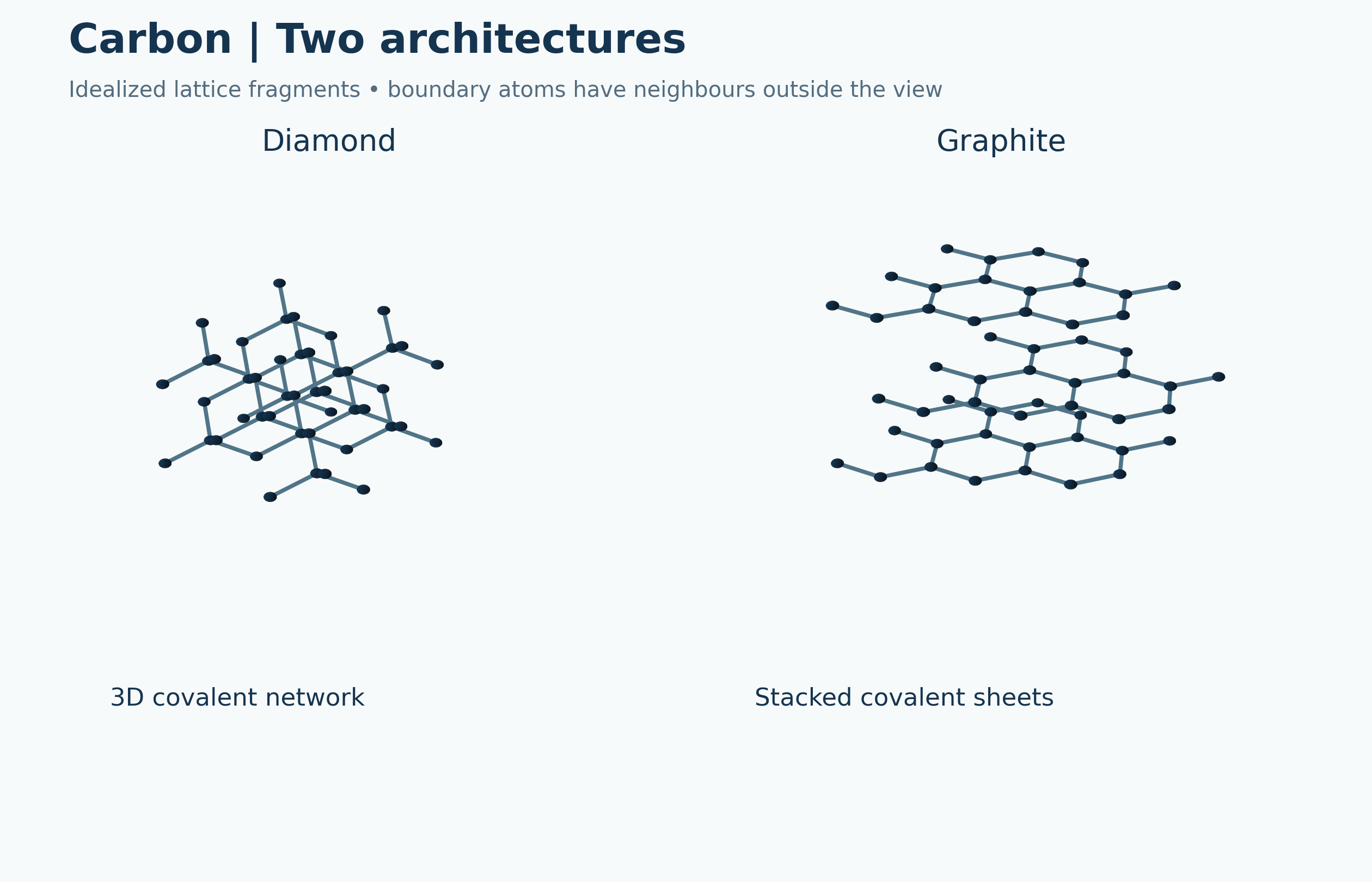
Two architectures
Idealised fragments contrast diamond’s three-dimensional network with graphite’s stacked sheets.
Download original PNG
Idealised model
Bonding networks
Diamond’s four neighbours per bulk atom are compared with three neighbours per graphite-sheet atom.
Download original PNG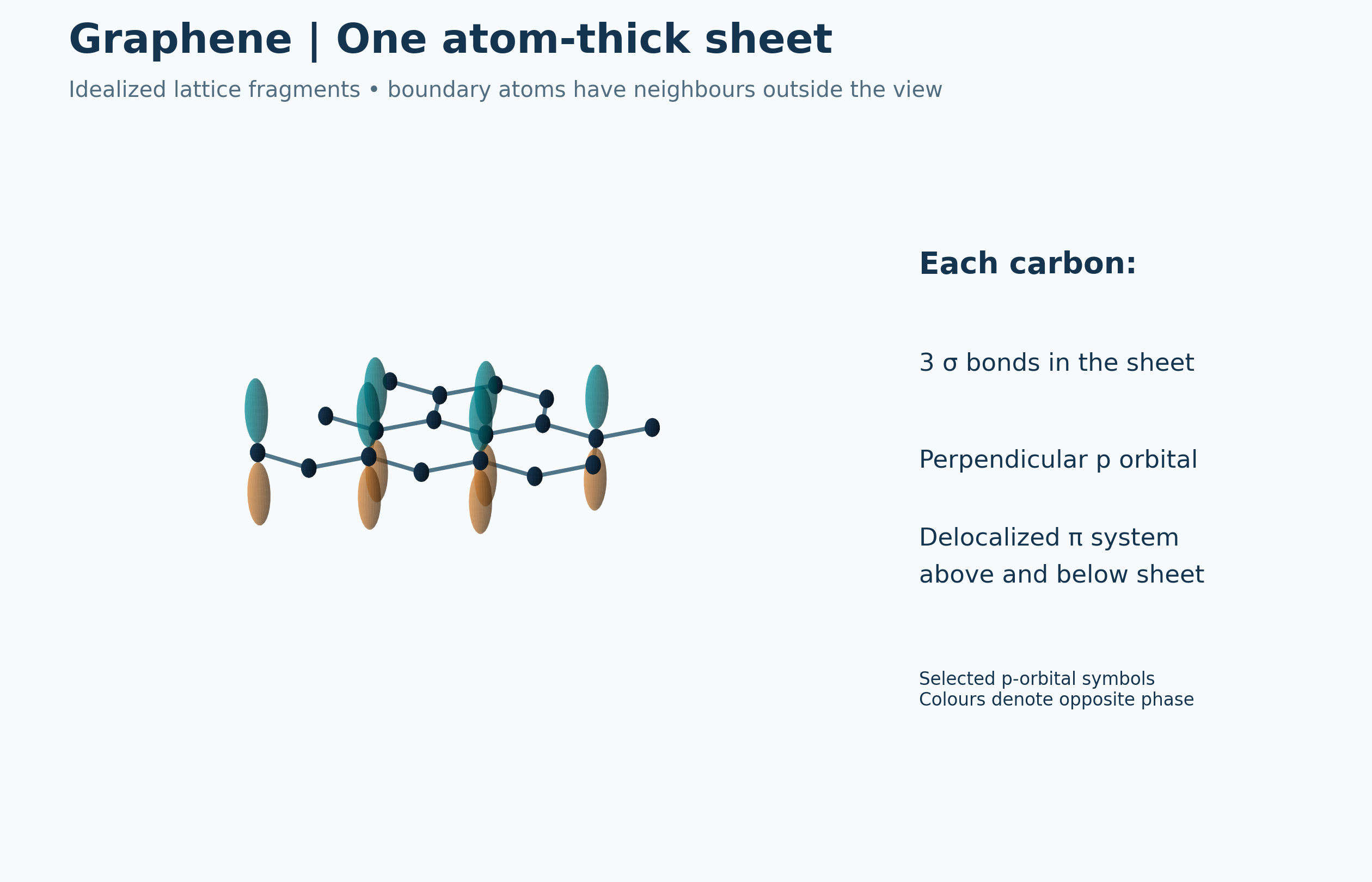
Idealised model
One atom-thick sheet
A graphene fragment shows in-plane sigma bonding and symbolic perpendicular p orbitals.
Download original PNG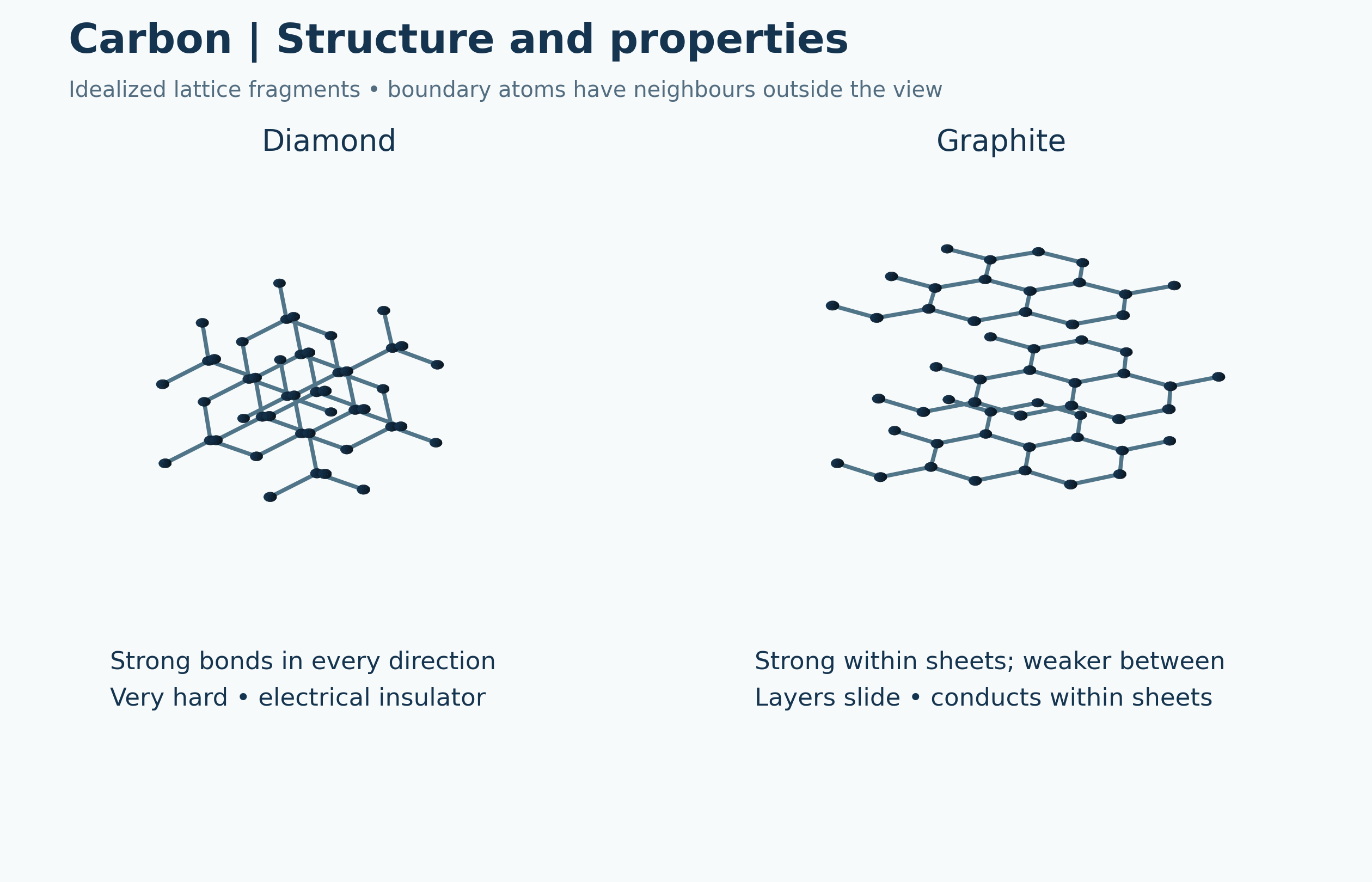
Idealised model
Structure and properties
Network differences are connected with hardness, sliding layers and electrical conduction.
Download original PNG
Idealised model
Three related structures
Side-by-side lattice fragments compare diamond, graphite and graphene.
Download original PNGAbout these representations
Idealised lattice fragments; boundary atoms have neighbours outside the view. Orbital symbols indicate phase, not calculated charge-density surfaces.