
A carbonyl combines trigonal planar geometry with a polar C=O bond. Formaldehyde illustrates how nucleophilic addition changes the carbon geometry.
Choose from five images below. Open an image for a closer look, download its original PNG, or download all five as a ZIP.
Use these visuals in your lesson
Follow both electron-pair arrows before comparing the planar reactant with the tetrahedral addition intermediate.
A question to discuss
Why does a nucleophile attack the carbon rather than the oxygen in this example?
Carbonyl geometry and polarity: five teaching visuals
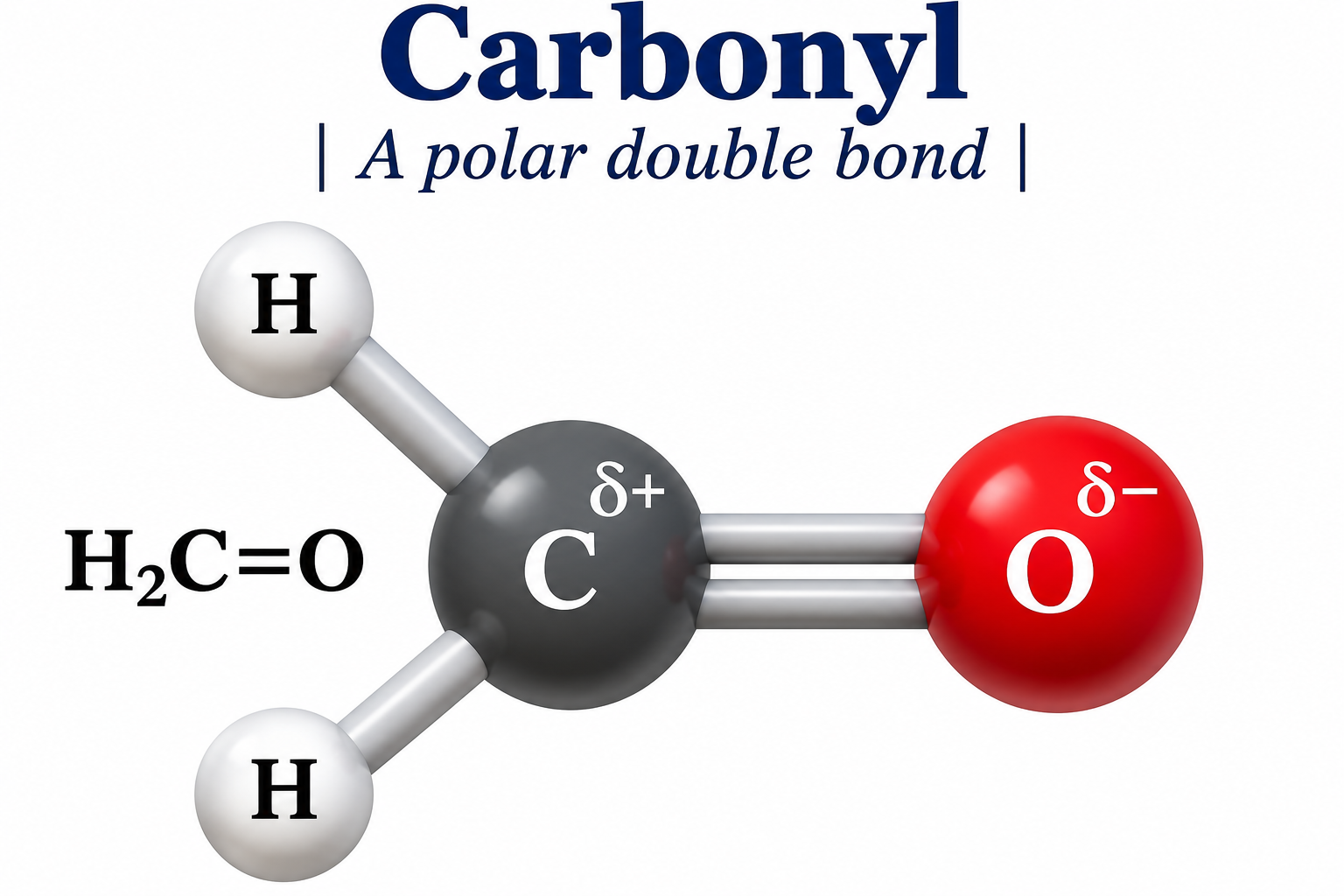
A polar carbonyl bond
A polar carbonyl bond
Formaldehyde is shown with partially positive carbon and partially negative oxygen.
Download original PNG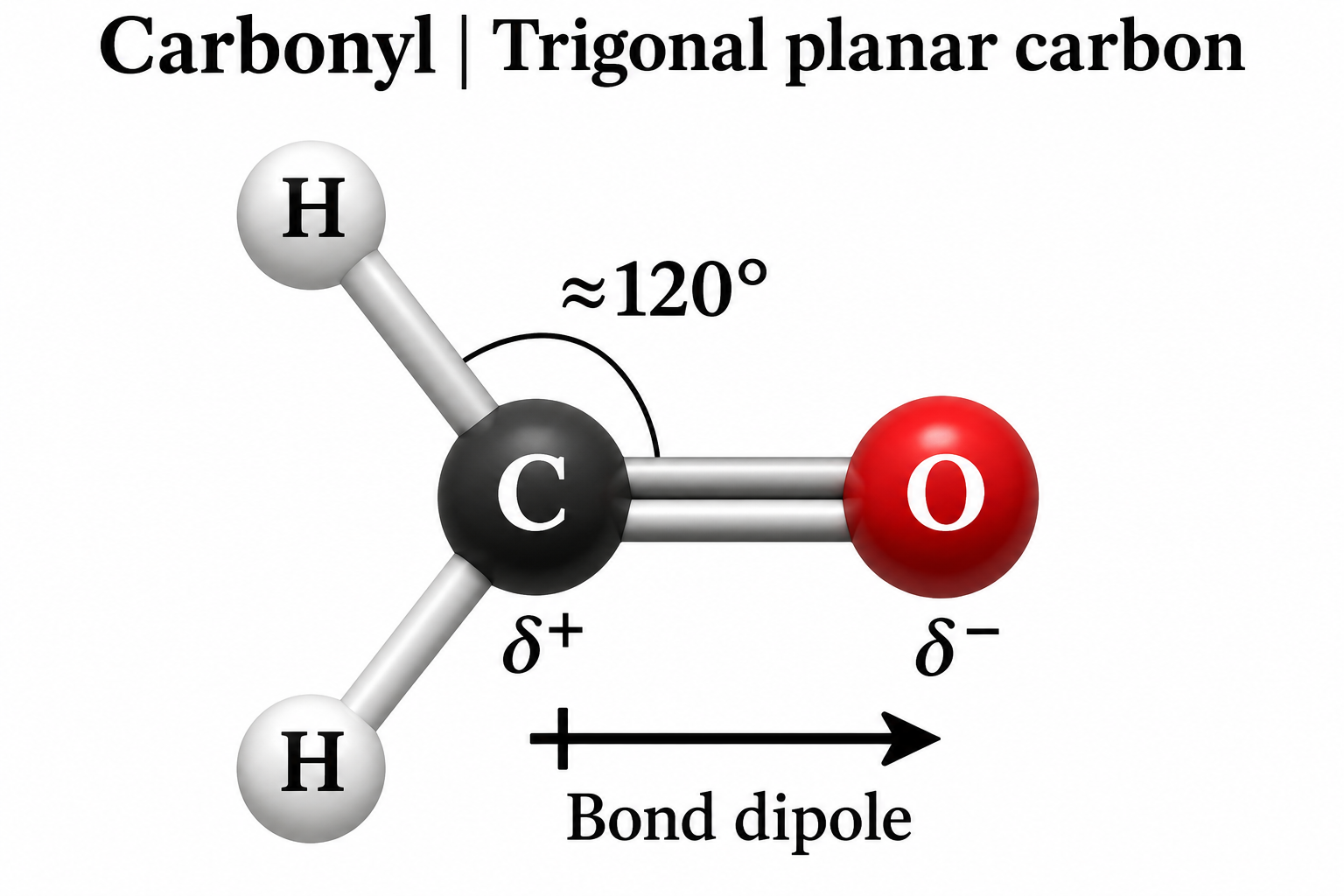
Trigonal planar carbon
Trigonal planar carbon
A formaldehyde model shows an approximately 120-degree angle and a bond dipole towards oxygen.
Download original PNG
Sigma and pi components
Sigma and pi components
A schematic orbital model separates the sigma framework from pi overlap above and below the molecular plane.
Download original PNG
Electron-pair arrows in addition
Electron-pair arrows in addition
One arrow runs from the nucleophile lone pair to carbon; another moves the C=O pi pair to oxygen.
Download original PNG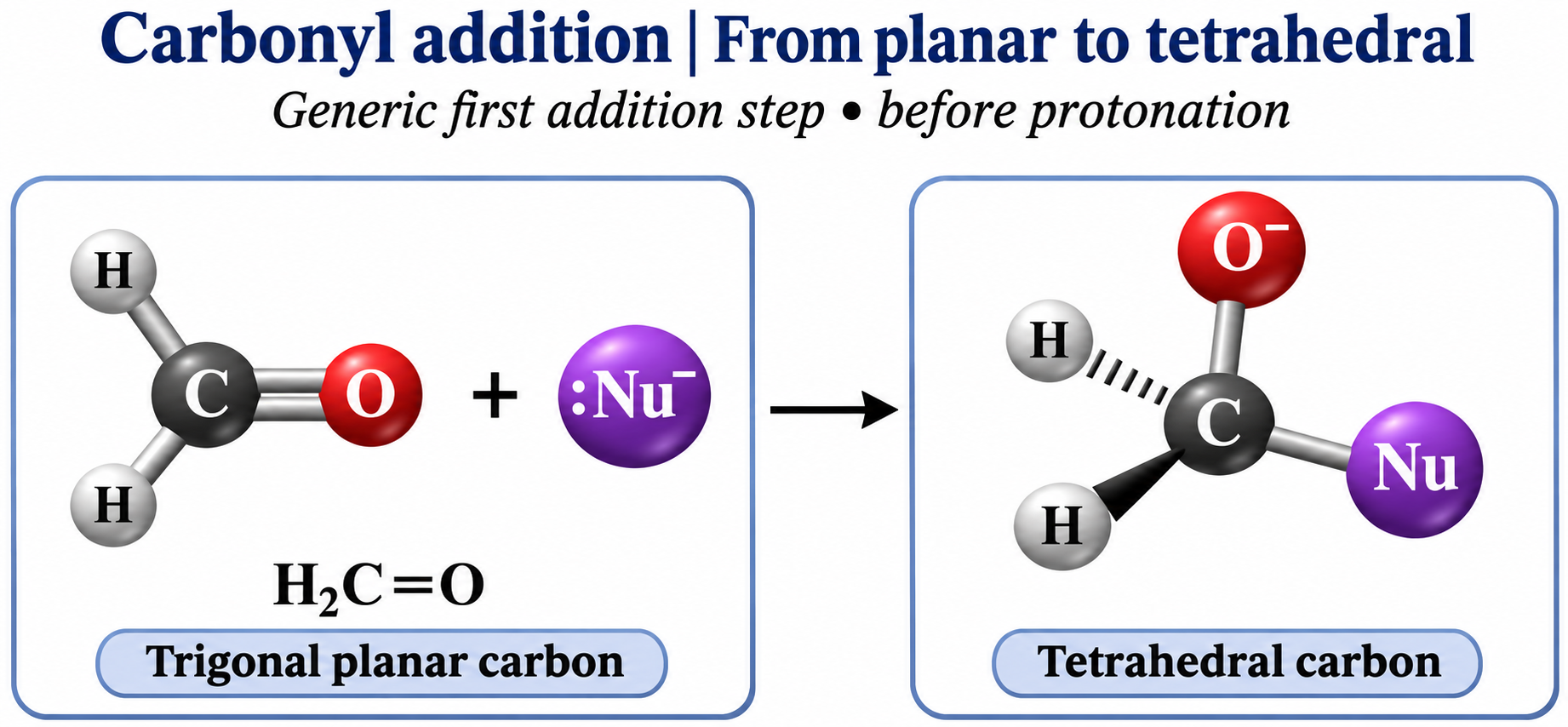
Planar to tetrahedral
Planar to tetrahedral
A generic nucleophilic addition step gives tetrahedral carbon and negatively charged oxygen before protonation.
Download original PNGAbout these representations
Illustrative formaldehyde geometry and orbital model; partial charges are not formal charges or a calculated density map.