
Copper electroplating deposits copper on the negative electrode. A soluble copper anode supplies copper ions as it is oxidised.
Choose from five images below. Open an image for a closer look, download its original PNG, or download all five as a ZIP.
Use these visuals in your lesson
Label oxidation and reduction first, then connect the half-equations with electrode mass changes.
A question to discuss
What assumptions allow anode mass loss to equal cathode mass gain?
Electroplating with copper: five teaching visuals

Copper plating apparatus
Copper plating apparatus
A copper anode and object cathode sit in copper-ion solution connected to a DC supply.
Download original PNG
Copper deposits on the object
Copper deposits on the object
Copper ions gain electrons at the negative cathode, illustrated by a plated key.
Download original PNG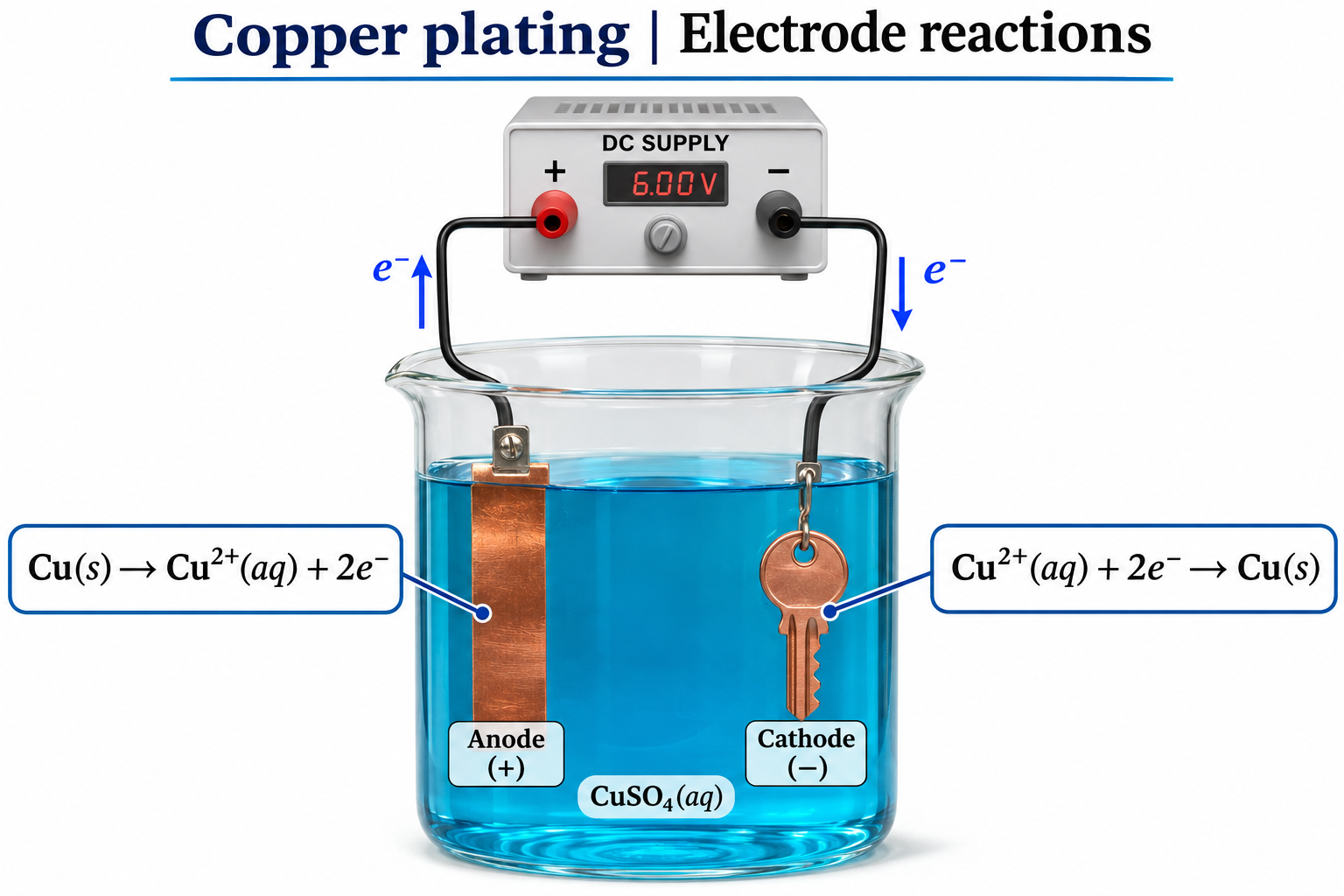
The electrode half-equations
The electrode half-equations
Copper oxidation at the anode and copper-ion reduction at the cathode accompany external electron arrows.
Download original PNG
Electrode mass changes
Electrode mass changes
Before-and-after views show equal copper mass lost and gained under ideal conditions without side reactions.
Download original PNG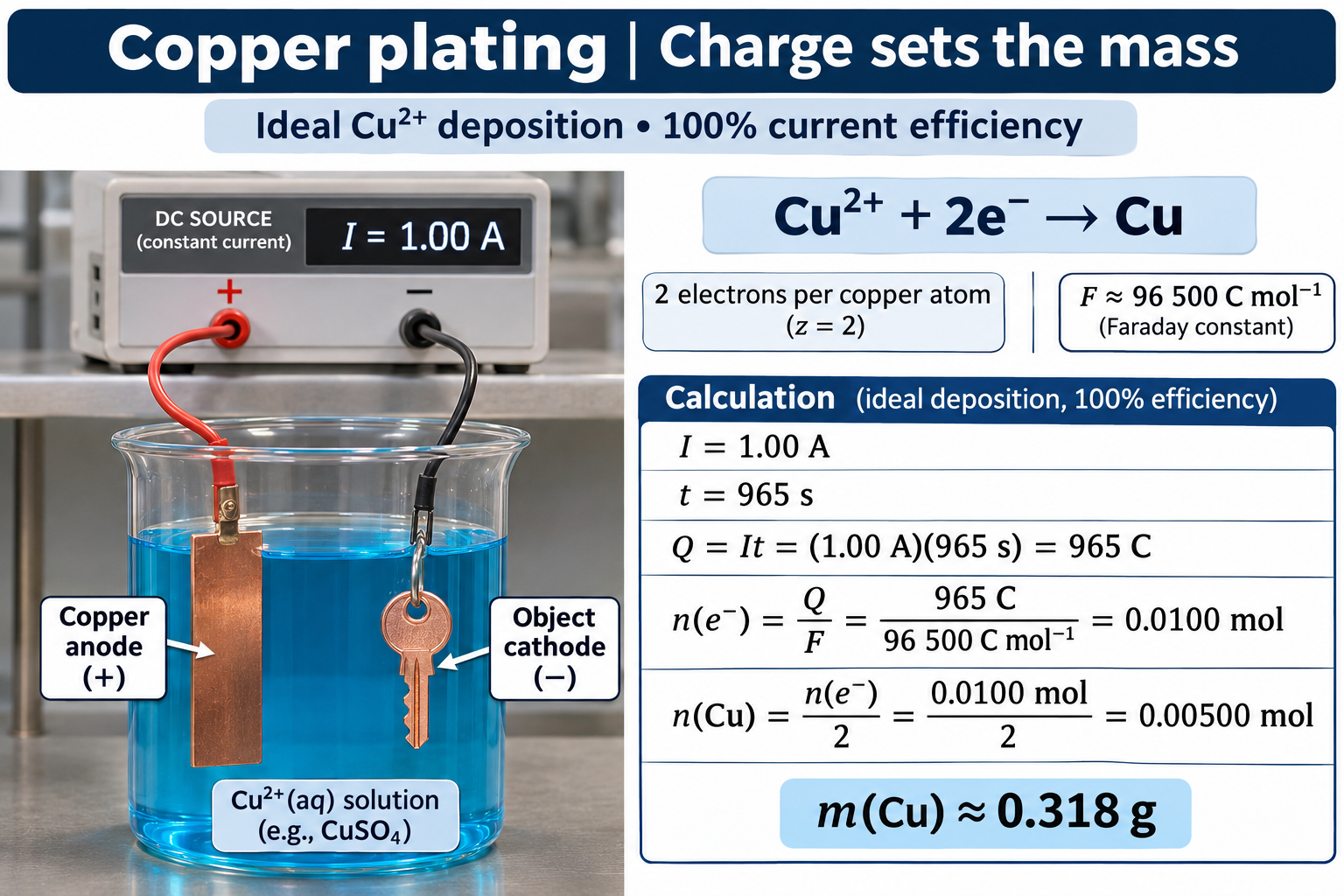
Charge determines deposited mass
Charge determines deposited mass
An ideal 1.00 A current for 965 s deposits approximately 0.318 g copper at 100 percent current efficiency.
Download original PNGAbout these representations
Illustrative apparatus, not recommended operating voltages; mass calculations assume ideal deposition and 100 percent current efficiency.