
Permanent dipoles make molecular orientation important. HCl provides a clear example for separating a polar bond from attraction between molecules.
Choose from five images below. Open an image for a closer look, download its original PNG, or download all five as a ZIP.
Use these visuals in your lesson
Have students trace the covalent bond and the dashed intermolecular attraction before comparing orientations.
A question to discuss
Does a polar molecule also experience London dispersion forces?
Dipole–dipole attractions: five teaching visuals
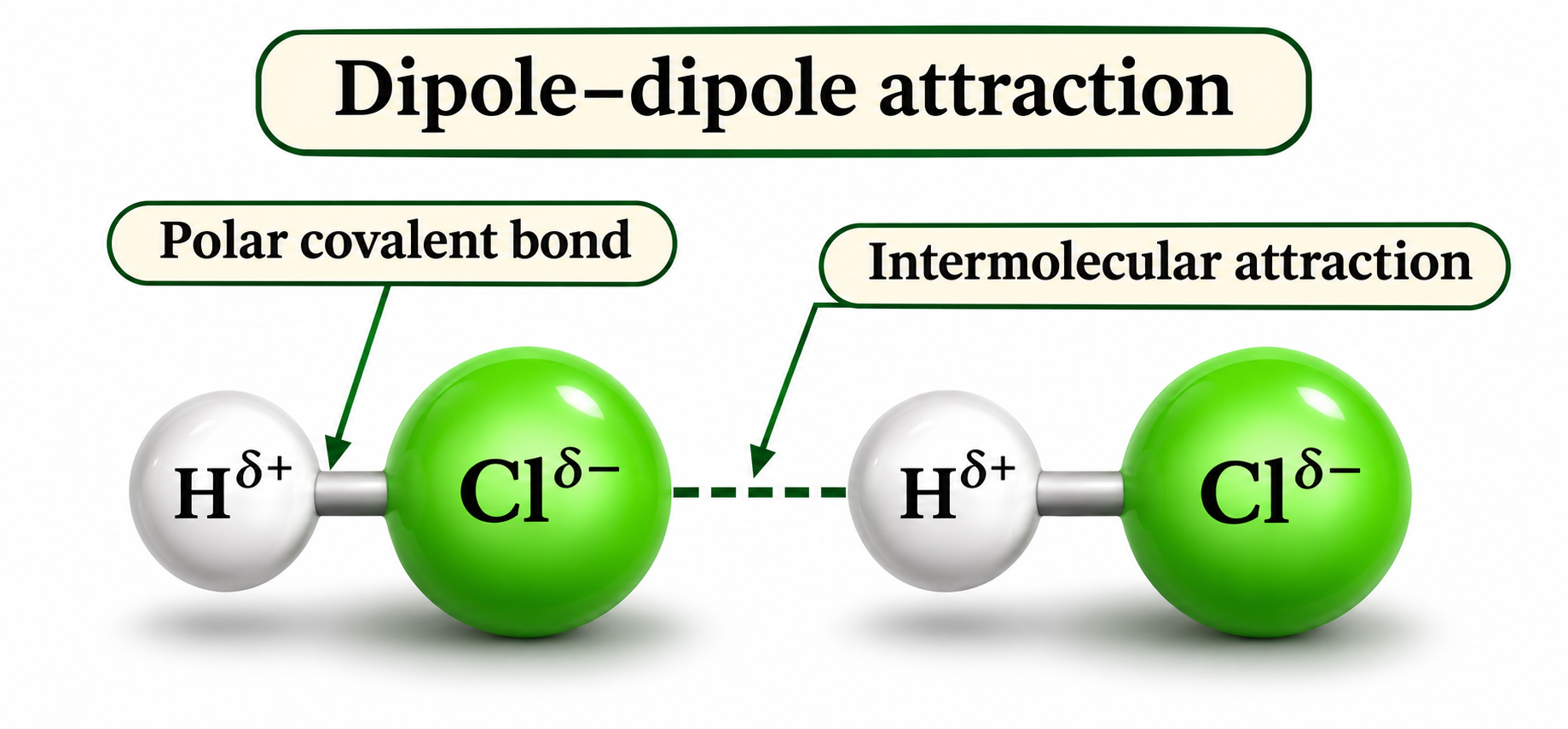
Bond or intermolecular attraction?
Bond or intermolecular attraction?
Two HCl molecules distinguish the polar covalent H–Cl bond from attraction between neighbouring molecules.
Download original PNG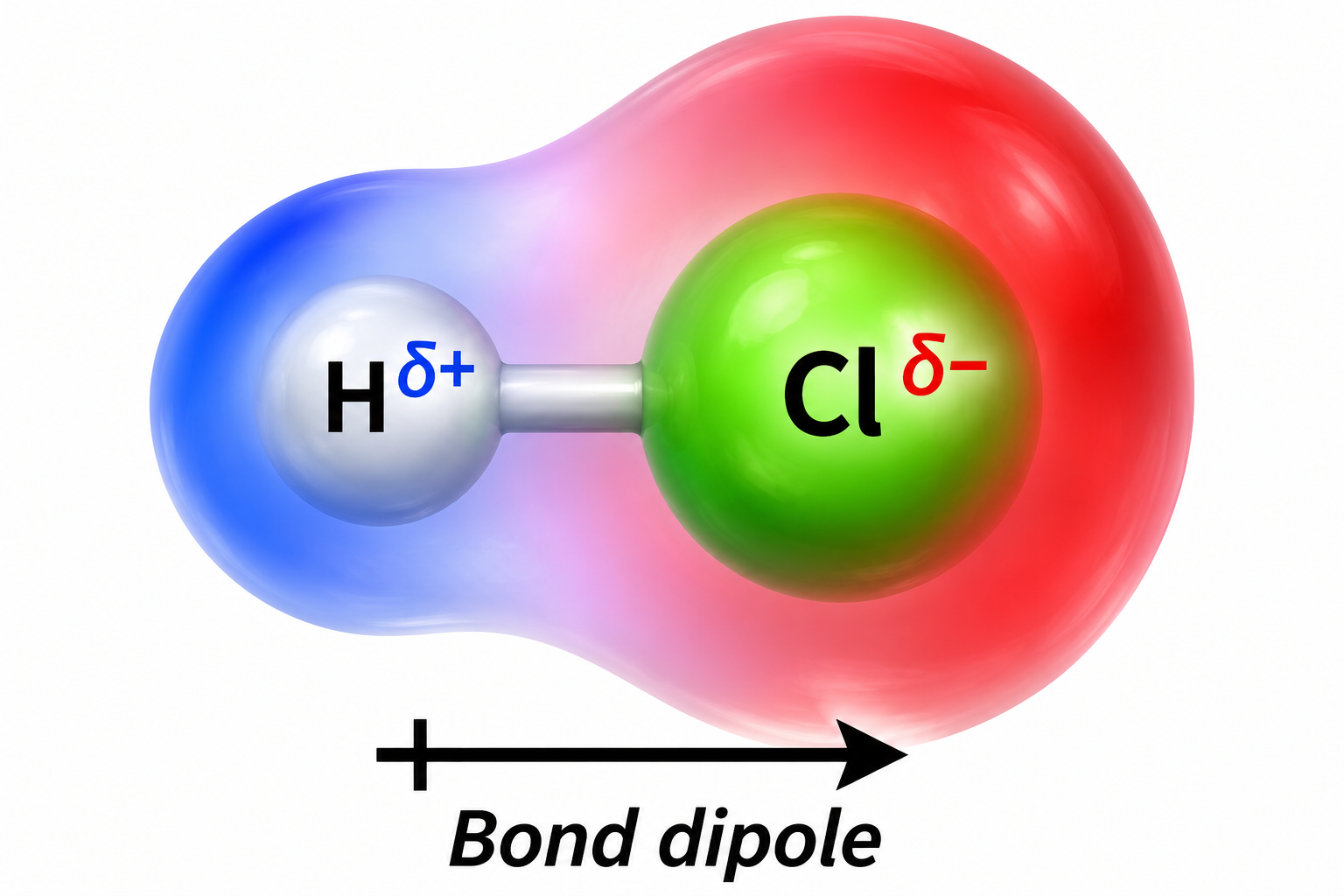
The HCl bond dipole
The HCl bond dipole
A coloured HCl envelope and positive-tail arrow show the dipole pointing towards chlorine.
Download original PNG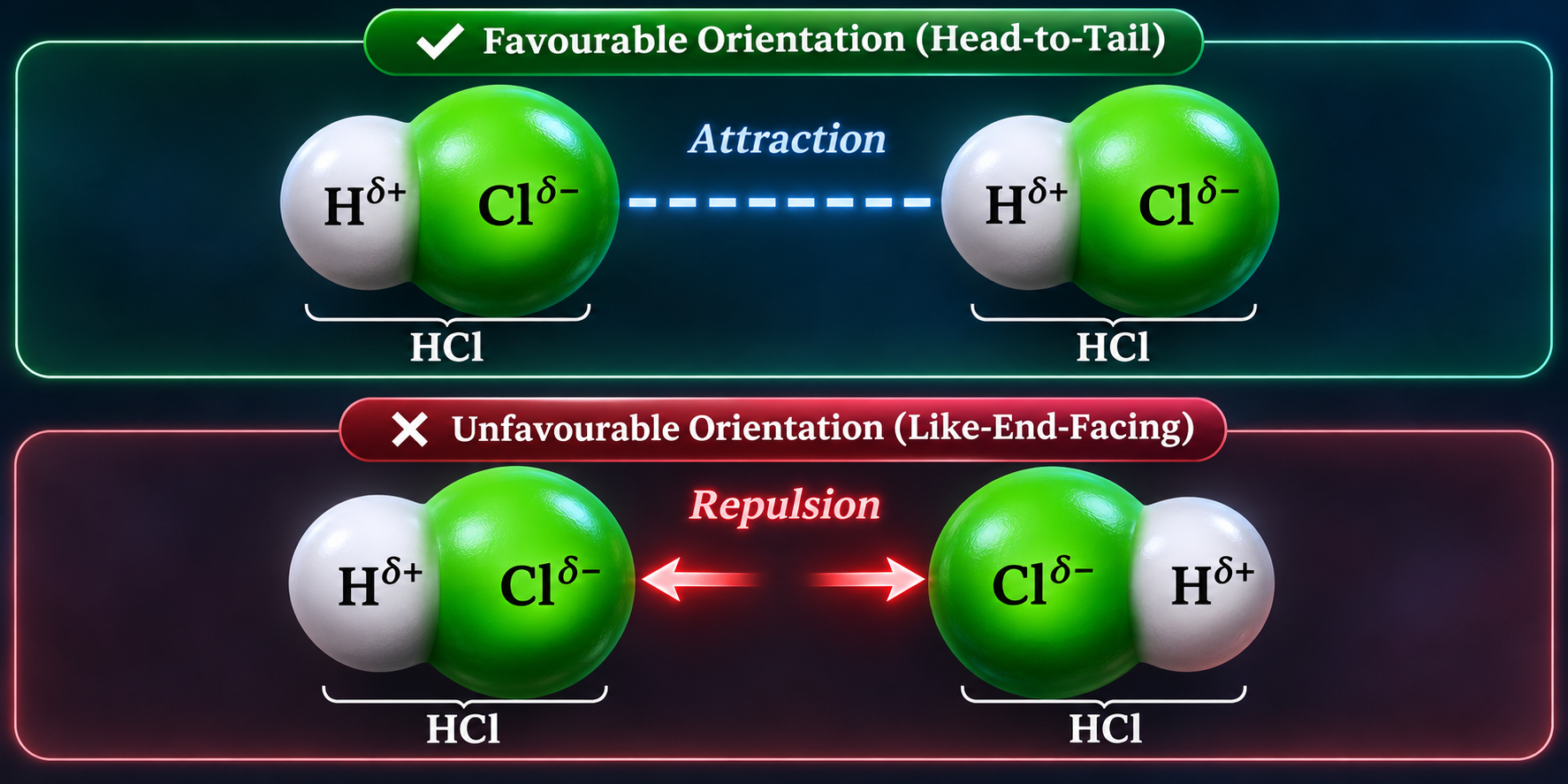
Favourable and unfavourable orientations
Favourable and unfavourable orientations
Head-to-tail HCl molecules attract; an arrangement with like partial charges facing illustrates repulsion.
Download original PNG
Moving and rotating polar molecules
Moving and rotating polar molecules
Several HCl molecules illustrate motion, rotation and favourable attractive orientations.
Download original PNG
Nonpolar F2 and polar HCl
Nonpolar F2 and polar HCl
F2 has London dispersion; HCl has dispersion and permanent dipole–dipole attractions.
Download original PNGAbout these representations
Schematic molecular shapes and partial charges, not calibrated molecular geometry.