
Build electron configurations with orbital boxes, then consider exceptions and ion formation.
Choose from five images below. Open an image for a closer look, download its original PNG, or download all five as a ZIP.
Use these visuals in your lesson
Count every electron and check spin pairing before applying a memorised filling order.
A question to discuss
Why are the 4s electrons removed when neutral iron forms Fe2+?
Electron configurations and orbital filling: five teaching visuals

Teaching illustration
Hydrogen and helium
Orbital boxes compare one electron in hydrogen with paired opposite spins in helium.
Download original PNG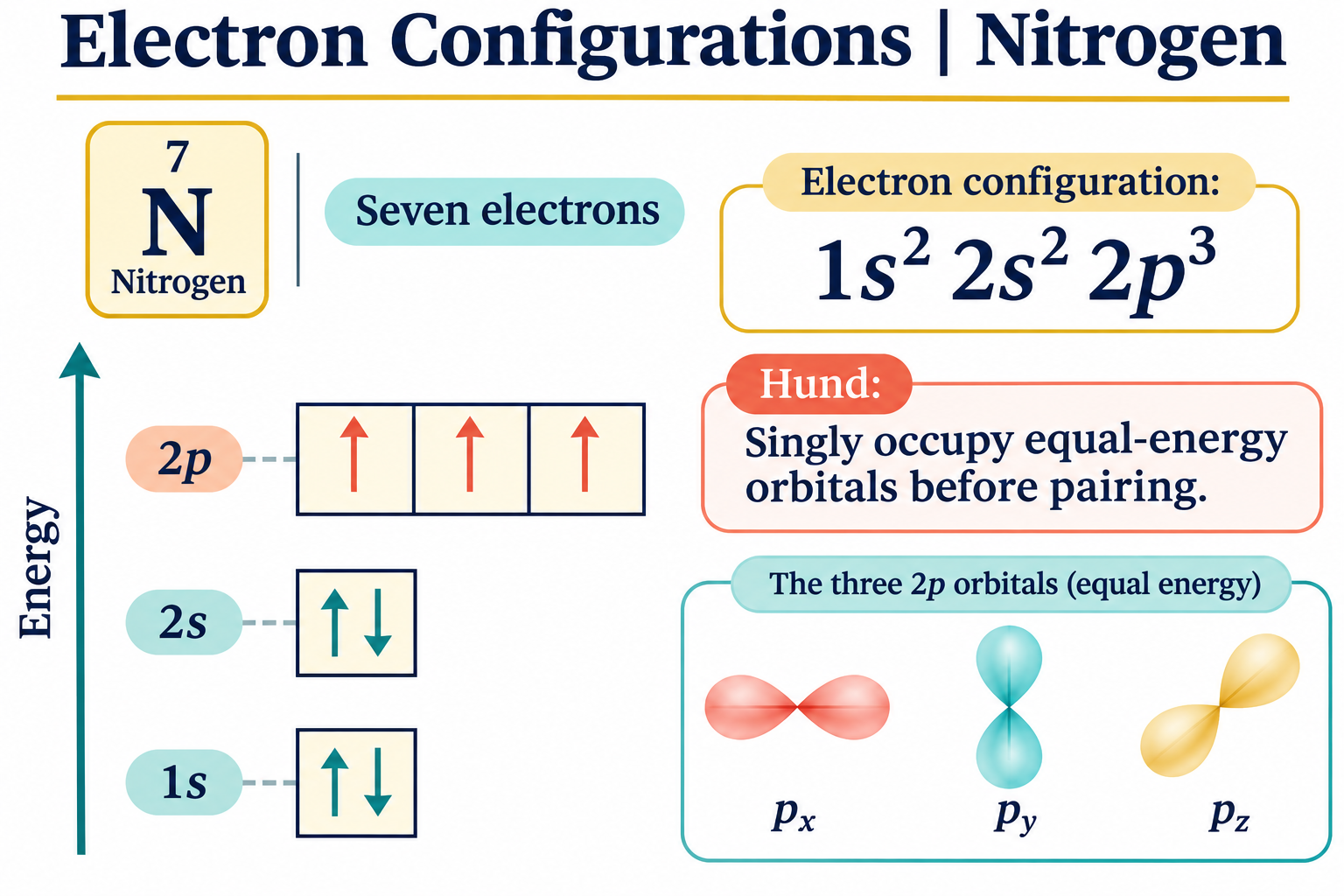
Teaching illustration
Nitrogen and Hund’s rule
Nitrogen’s seven electrons occupy 1s, 2s and three singly filled 2p orbitals.
Download original PNG
Teaching illustration
Three filling principles
Aufbau, Pauli and Hund rules summarise a useful ground-state building method with exceptions.
Download original PNG
Teaching illustration
Chromium and copper exceptions
Observed chromium and copper configurations are compared with naive filling predictions.
Download original PNG
Teaching illustration
Forming Fe2+
An iron orbital diagram removes two 4s electrons to leave the [Ar]3d6 configuration.
Download original PNGAbout these representations
Original teaching illustrations; symbolic particles and geometry are not calibrated measurements.