
Electronegativity describes attraction for shared electrons in a bond. Periodic patterns help explain bond polarity, but bonding is not divided by a universal numerical cutoff.
Choose from five images below. Open an image for a closer look, download its original PNG, or download all five as a ZIP.
Use these visuals in your lesson
Use the Pauling values to predict partial charges, then check the direction of the bond-dipole arrow.
A question to discuss
Why is electronegativity difference a guide rather than a complete description of bonding?
Electronegativity trends: five teaching visuals

Unequal sharing in HCl
Unequal sharing in HCl
Hydrogen 2.20 and chlorine 3.16 illustrate attraction towards chlorine and the resulting partial charges.
Download original PNG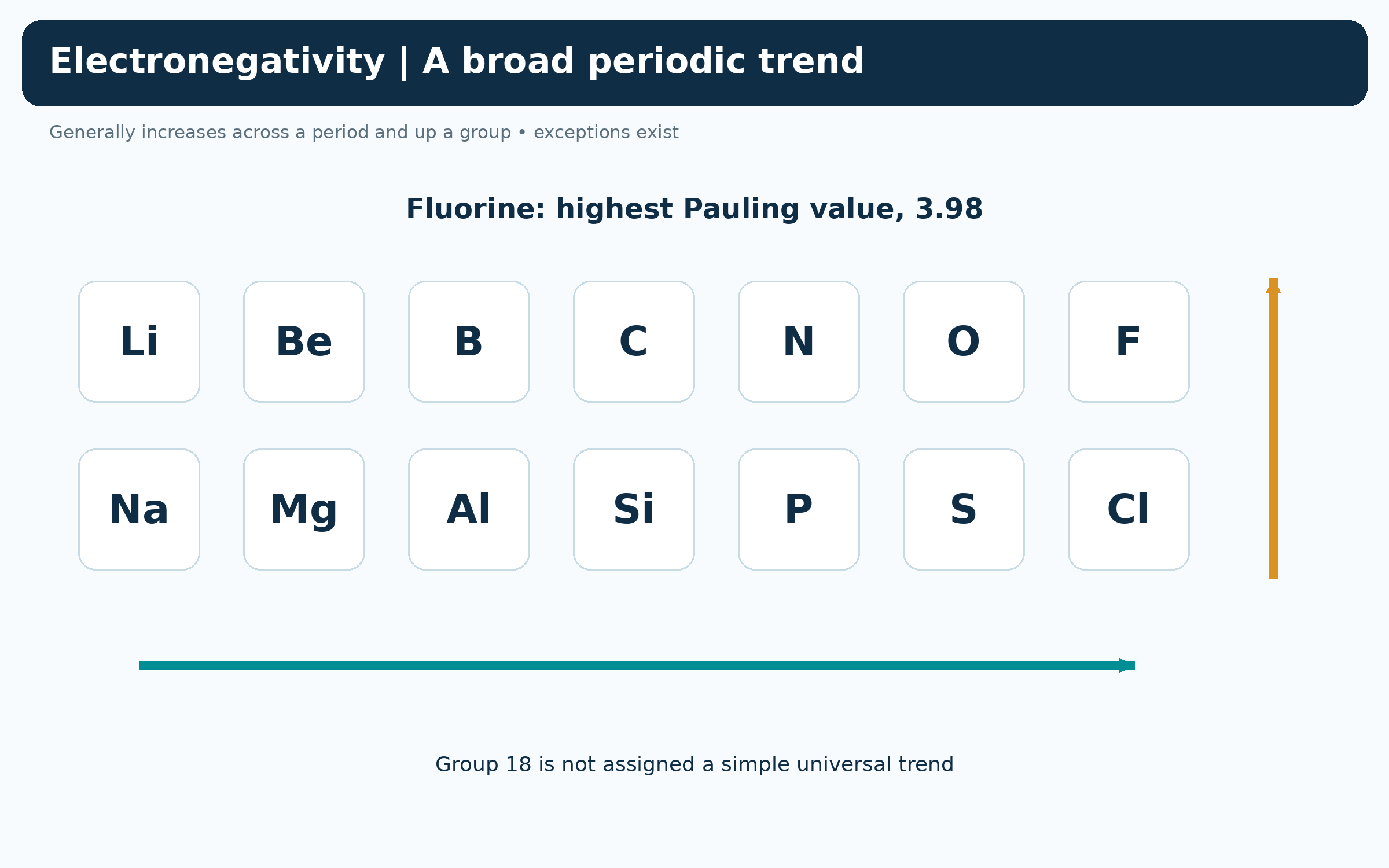
A broad periodic trend
A broad periodic trend
Selected period-two and period-three elements show electronegativity generally increasing across and up the table.
Download original PNG
Comparing Pauling values
Comparing Pauling values
A bar chart compares hydrogen, carbon, chlorine, oxygen and fluorine on the Pauling scale.
Download original PNG
Reading bond-dipole arrows
Reading bond-dipole arrows
H–Cl and C–O bond fragments show arrows from the positive end towards the more electronegative atom.
Download original PNG
A bonding continuum
A bonding continuum
Cl–Cl, H–Cl and ions in sodium chloride contrast equal sharing, unequal sharing and ionic bonding.
Download original PNGAbout these representations
Pauling electronegativity values; bond fragments are not isolated CO molecular-dipole models.