
Follow electron and ion movement through a zinc–copper galvanic cell.
Choose from five images below. Open an image for a closer look, download its original PNG, or download all five as a ZIP.
Use these visuals in your lesson
Trace the external electron route separately from the salt-bridge ions before writing half-equations.
A question to discuss
Why does a salt bridge need mobile ions rather than electrons to complete the circuit?
Galvanic cell: five teaching visuals

Teaching illustration
The cell circuit
A zinc–copper cell shows the external electron path and a salt bridge between half-cells.
Download original PNG
Teaching illustration
Oxidation and reduction
Zinc oxidation at the negative anode is paired with copper-ion reduction at the positive cathode.
Download original PNG
Teaching illustration
Completing the circuit
A potassium nitrate salt bridge supplies anions toward the anode and cations toward the cathode.
Download original PNG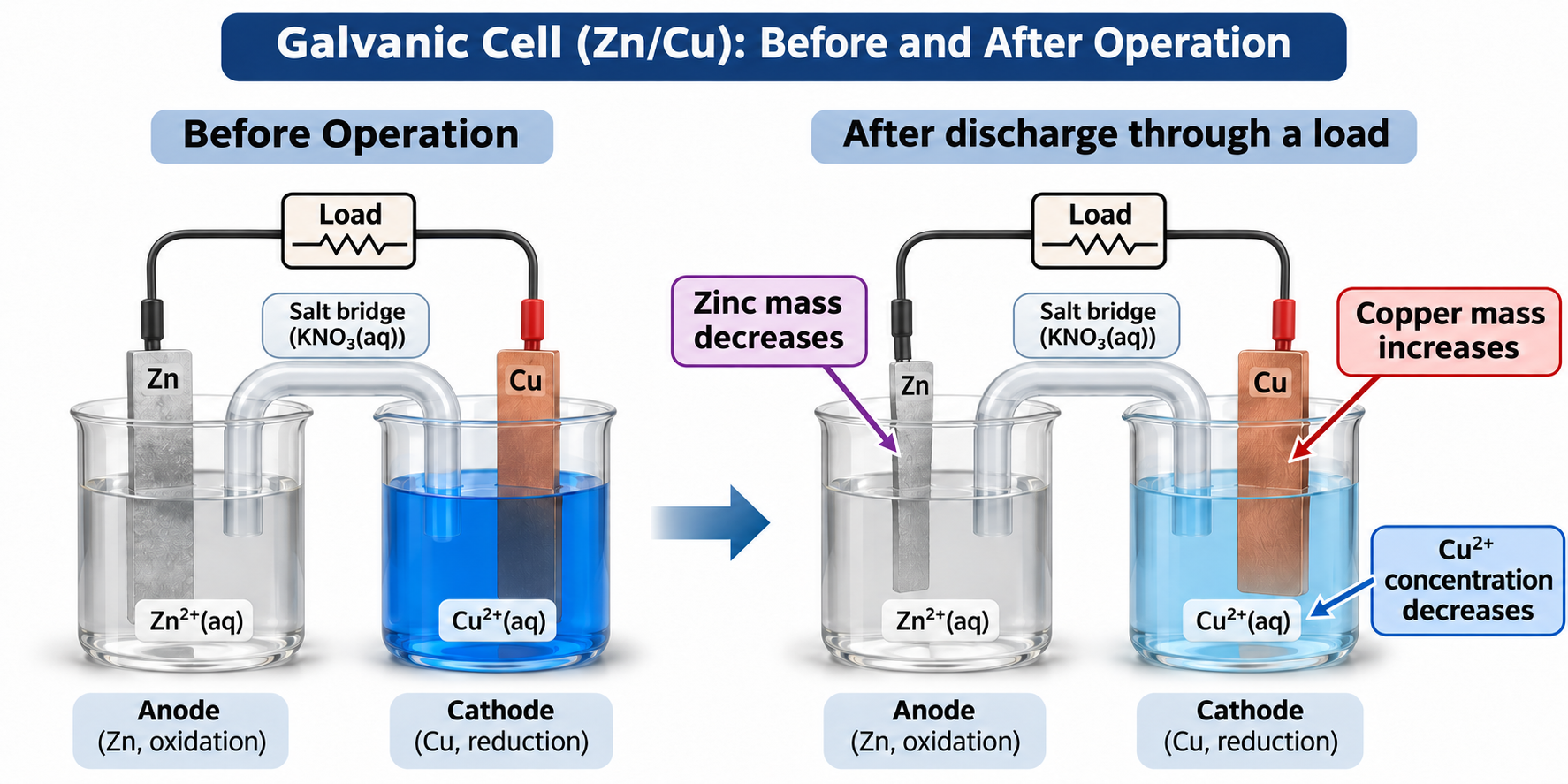
Teaching illustration
Before and after discharge
The zinc electrode loses mass while copper is deposited and copper-ion concentration falls.
Download original PNG
Teaching illustration
The overall reaction
A zinc–copper cell combines half-reactions, cell notation and an approximate standard potential of 1.10 V.
Download original PNGAbout these representations
Instructional apparatus reconstructions, not operating instructions; the standard-potential panel uses the stated 25°C conditions and textbook concentration approximation.