
The Haber process balances equilibrium yield, reaction rate and energy costs. Cooling removes ammonia while unreacted nitrogen and hydrogen are recycled.
Choose from five images below. Open an image for a closer look, download its original PNG, or download all five as a ZIP.
Use these visuals in your lesson
Trace the material flow, then explain why pressure, temperature and catalyst choices have different effects.
A question to discuss
Why does an iron catalyst speed ammonia production without changing equilibrium yield?
Haber process equilibrium and recycling: five teaching visuals
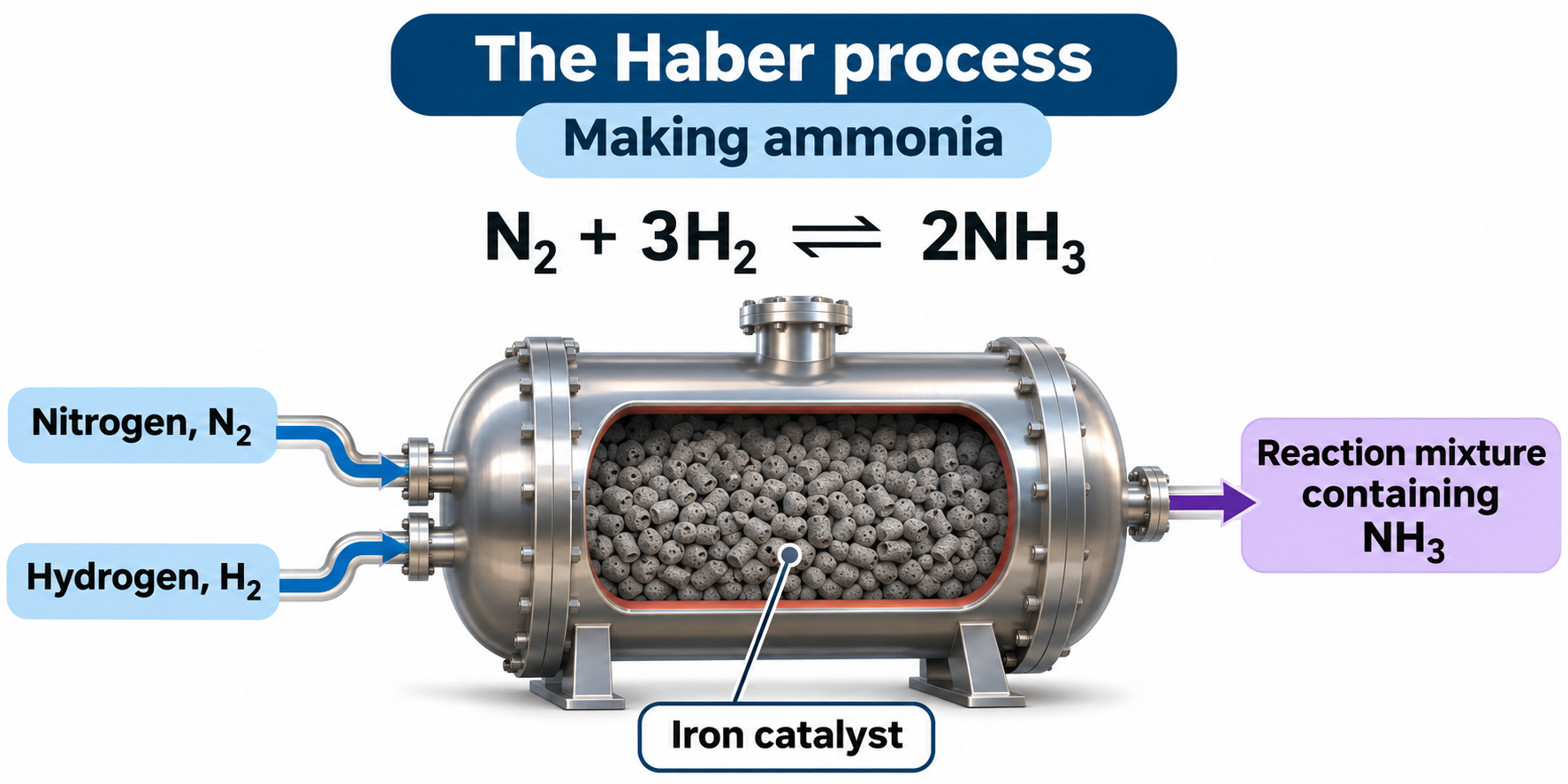
Making ammonia
Making ammonia
Nitrogen and hydrogen enter an iron-catalyst reactor, illustrating N2 + 3H2 ⇌ 2NH3.
Download original PNG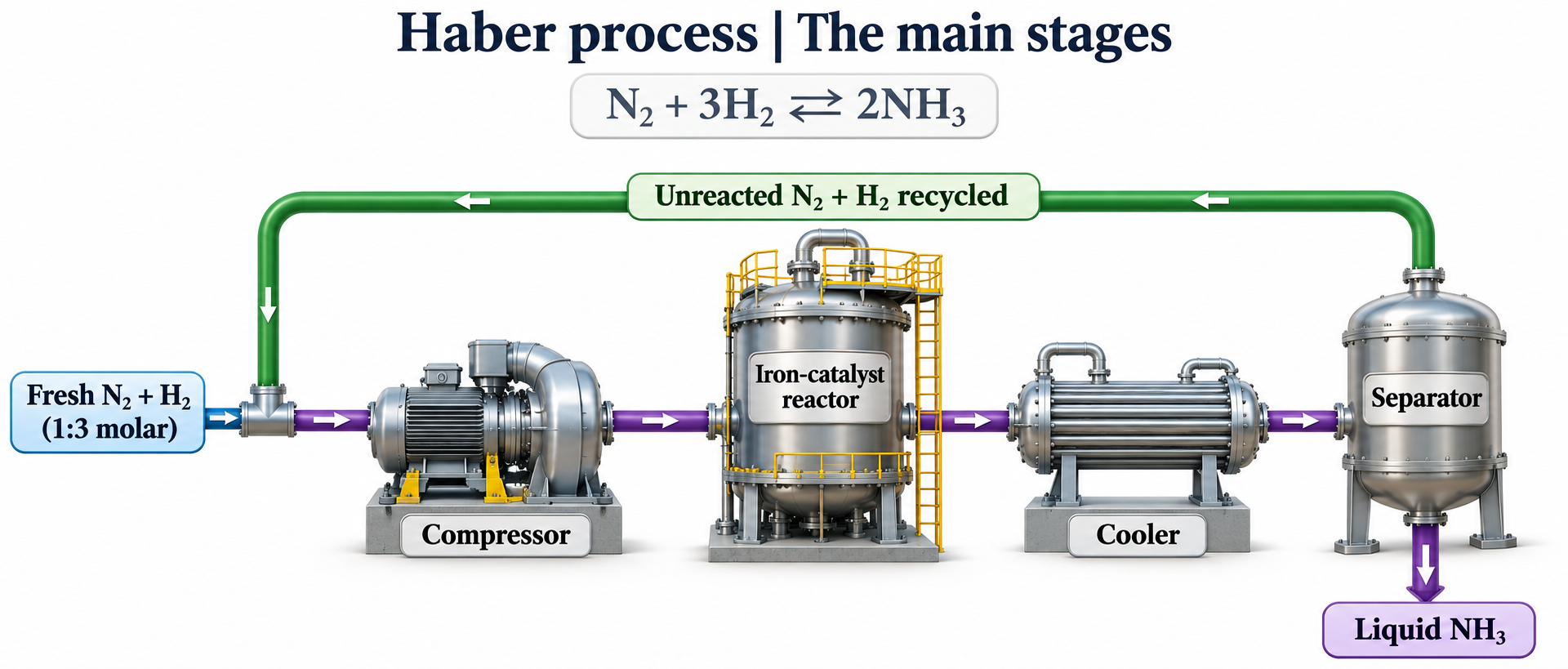
The main process stages
The main process stages
A simplified flow links feed, compressor, reactor, cooler and separator with unreacted-gas recycling.
Download original PNG
Yield compared with speed
Yield compared with speed
Pressure, temperature and catalyst panels compare equilibrium and rate effects for ammonia formation.
Download original PNG
Cooling separates ammonia
Cooling separates ammonia
A condenser and separator remove liquid ammonia while nitrogen and hydrogen return to the recycle loop.
Download original PNG
Recycling with a purge
Recycling with a purge
A simplified industrial flow includes product removal, recycled reactants and a small purge for accumulating inert gases.
Download original PNGAbout these representations
Simplified industrial flow and qualitative equilibrium comparisons, not an engineering blueprint.