
Explore hydrogen bonding between water molecules and contrast it with the covalent bonds inside each molecule.
Choose from five images below. Open an image for a closer look, download its original PNG, or download all five as a ZIP.
Use these visuals in your lesson
Have students identify donor and acceptor molecules before extending the idea to ice and liquid water.
A question to discuss
What changes when a hydrogen bond breaks, and what stays intact?
Hydrogen bonding in water: five teaching visuals

Teaching illustration
One hydrogen bond
Two water molecules show an intermolecular hydrogen bond beside intramolecular O–H bonds.
Download original PNG
Teaching illustration
Donor and acceptor
Partial charges identify a donor O–H group and an oxygen acceptor in hydrogen bonding.
Download original PNG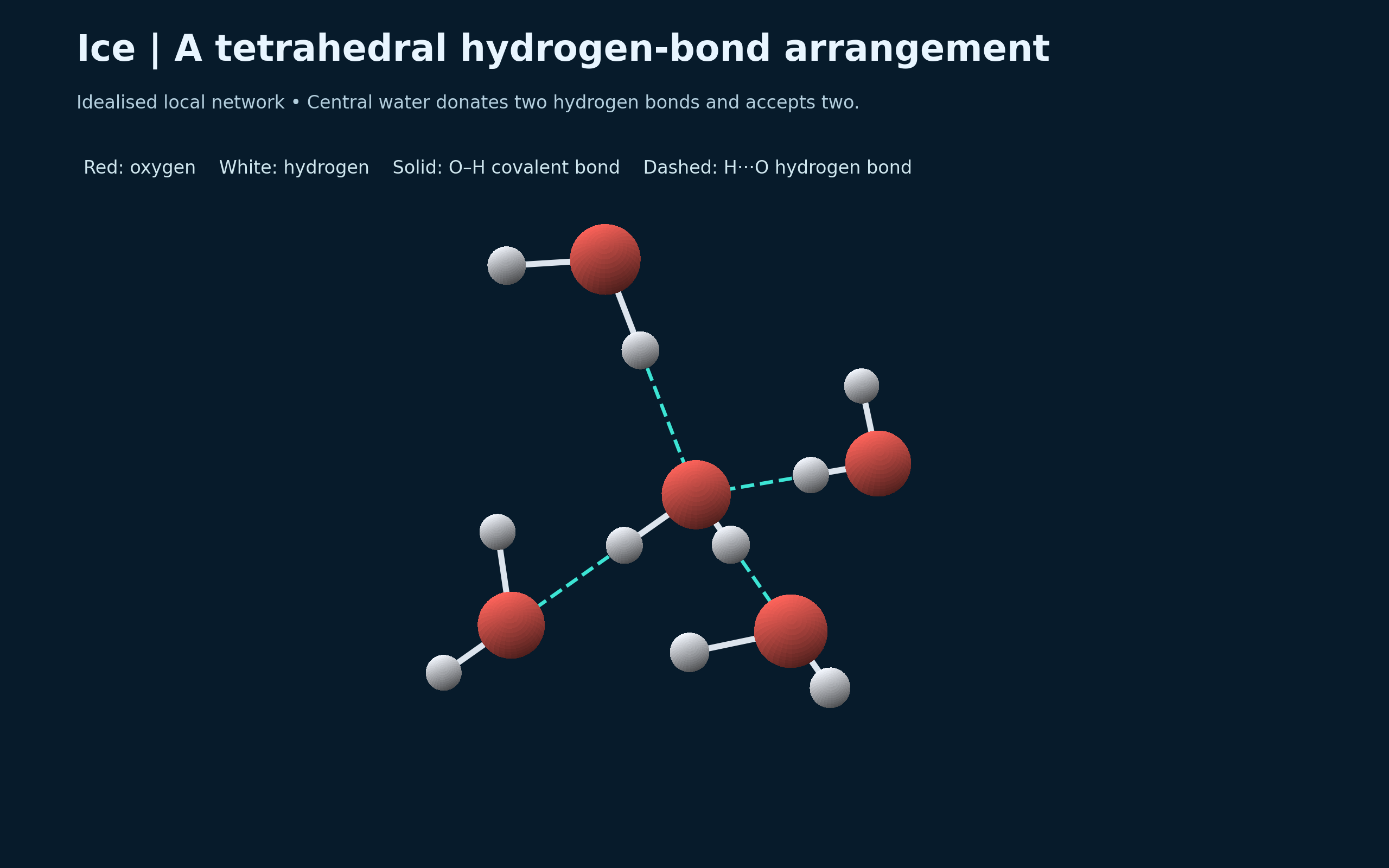
Teaching illustration
A tetrahedral arrangement in ice
An idealised local ice network shows a central water molecule donating two and accepting two hydrogen bonds.
Download original PNG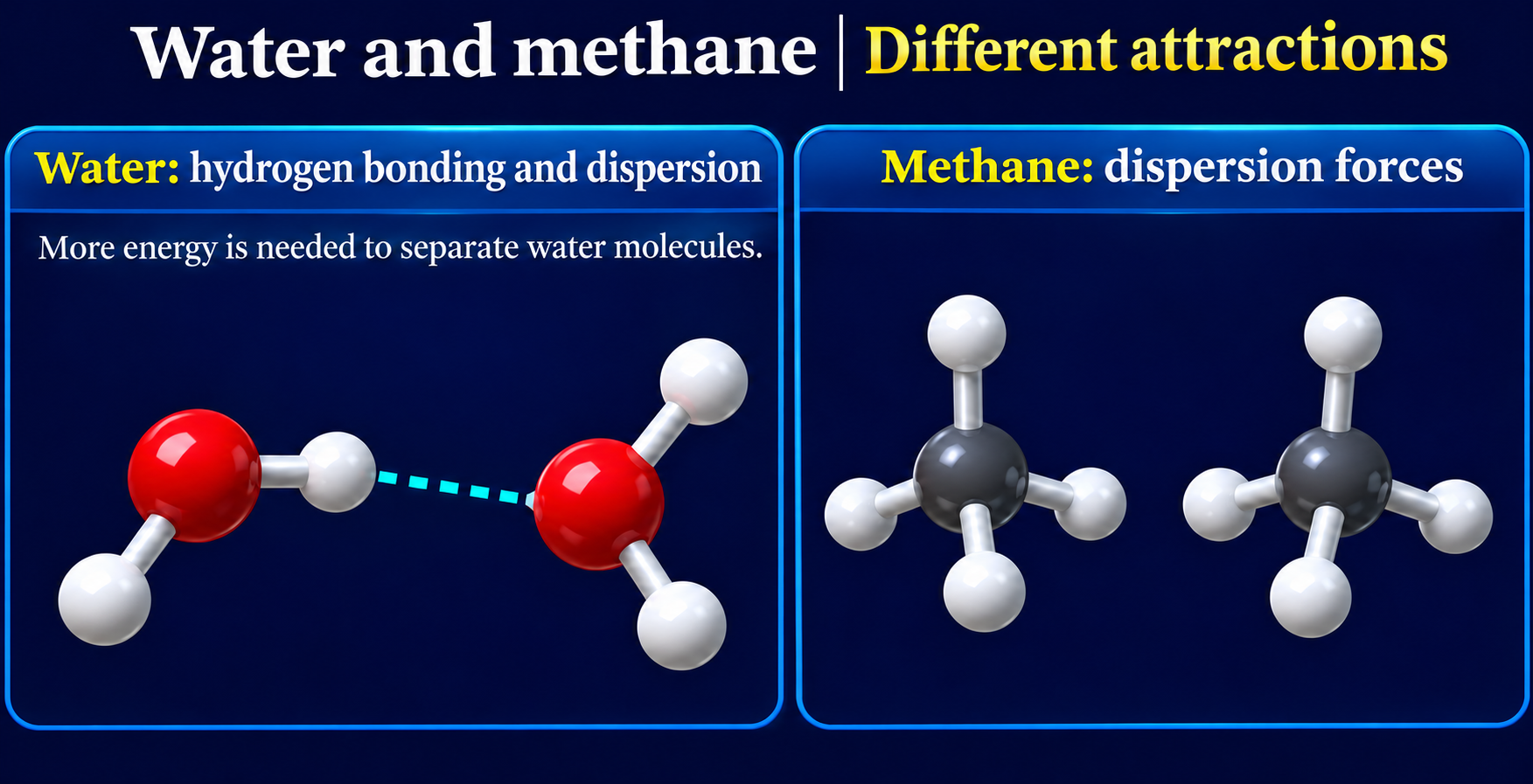
Teaching illustration
Water and methane
Molecular examples contrast hydrogen bonding and dispersion in water with dispersion in methane.
Download original PNG
Teaching illustration
A changing network
A conceptual liquid-water snapshot shows a hydrogen-bond network that continually forms and breaks.
Download original PNGAbout these representations
Illustrative molecular artwork plus an analytical ideal tetrahedral ice-network model; not a molecular-dynamics trajectory or a claim that liquid water has four permanent bonds per molecule.