
Isomers share a molecular formula but differ in connectivity or spatial arrangement. These examples separate constitutional isomerism from restricted rotation at a double bond.
Choose from five images below. Open an image for a closer look, download its original PNG, or download all five as a ZIP.
Use these visuals in your lesson
Have students check the formula first, then decide whether connectivity or arrangement has changed.
A question to discuss
Why are cis and trans but-2-ene not simply two freely rotating conformations?
Structural and geometric isomerism: five teaching visuals
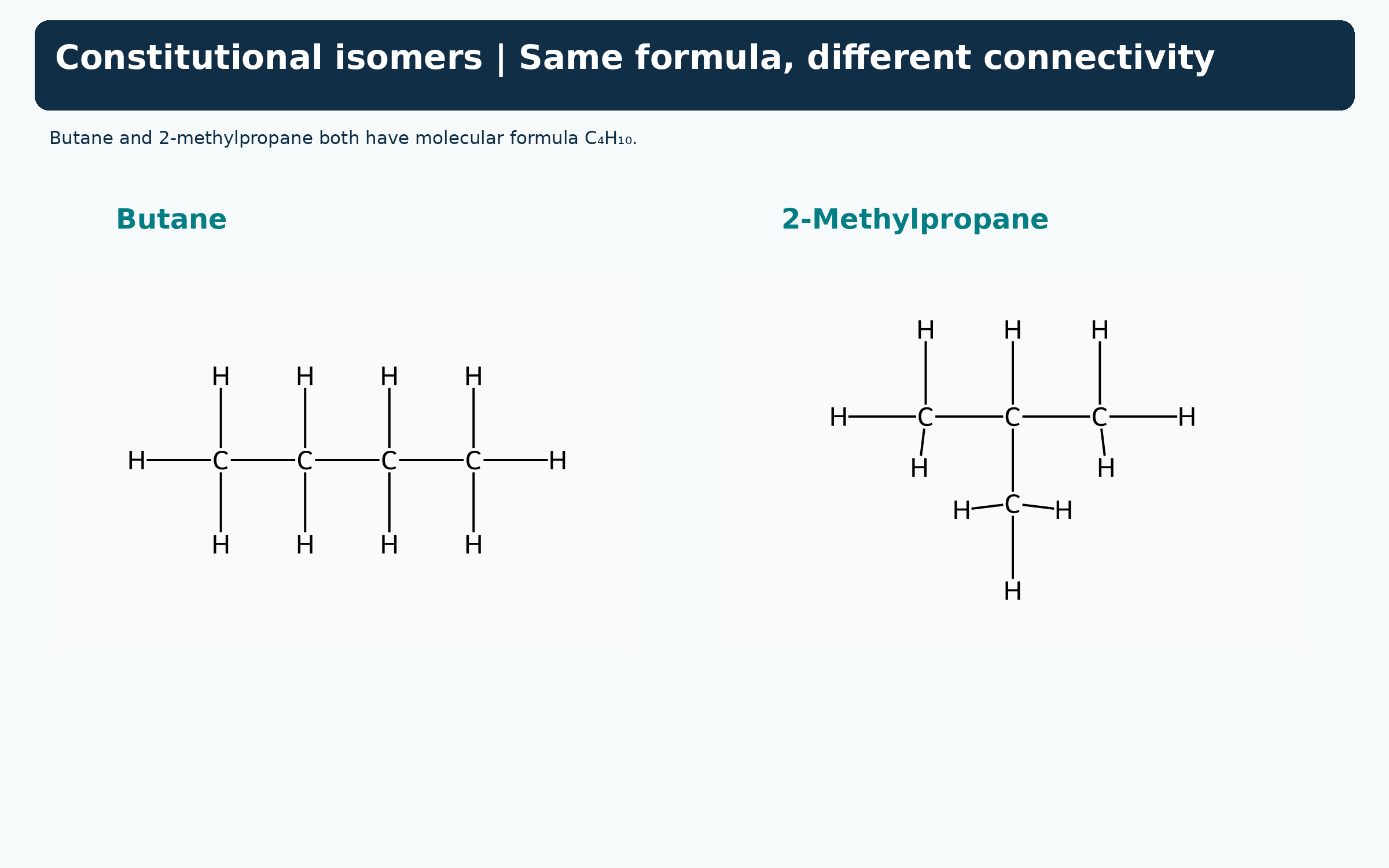
Same formula, different connectivity
Same formula, different connectivity
Displayed butane and 2-methylpropane are constitutional isomers with formula C4H10.
Download original PNG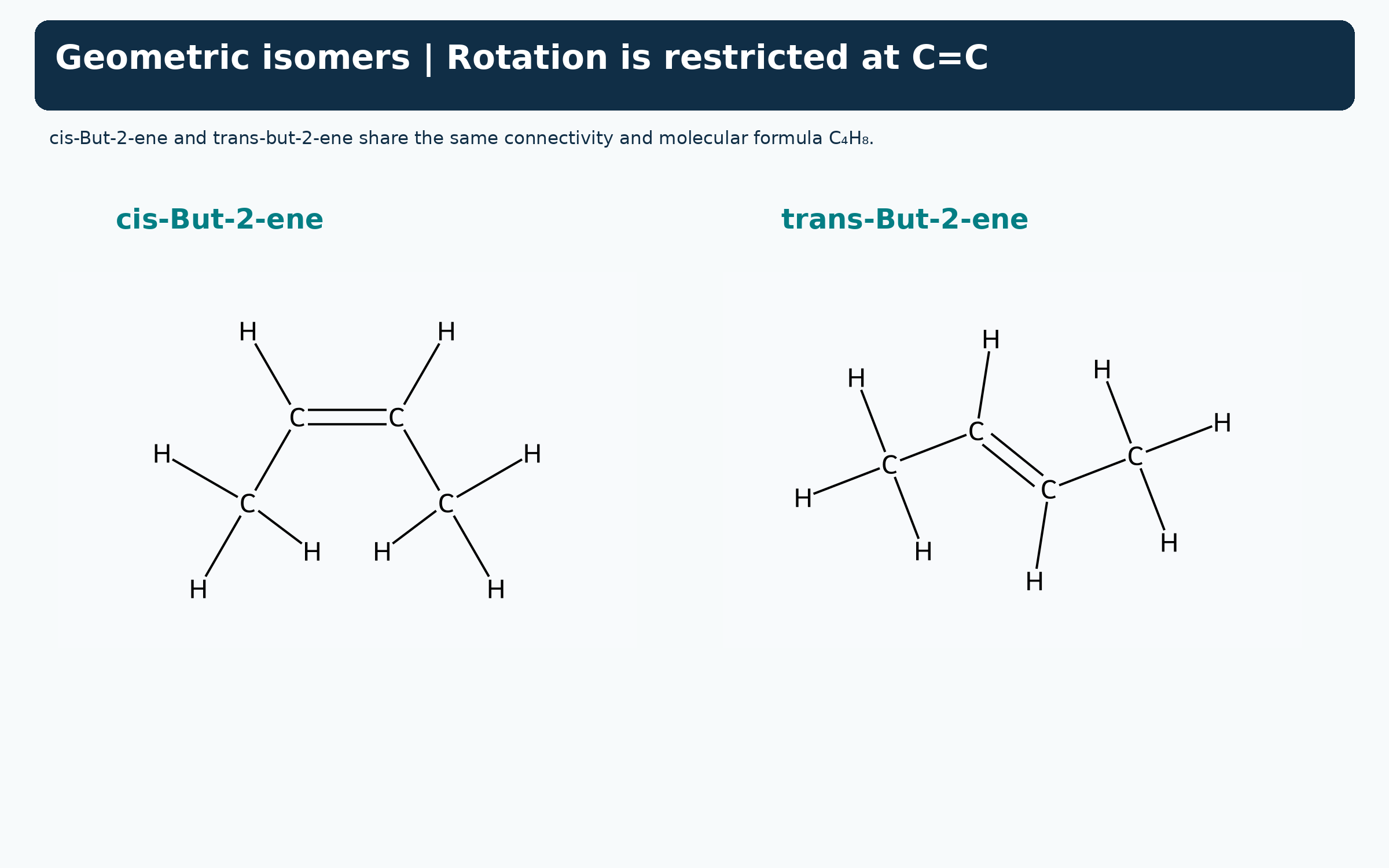
Cis and trans but-2-ene
Cis and trans but-2-ene
Displayed structures compare the methyl-group positions around a restricted C=C bond.
Download original PNG
Assigning E and Z priorities
Assigning E and Z priorities
Halogen-substituted alkenes compare higher-priority I and Br groups on the same or opposite sides.
Download original PNG
Two kinds of isomerism
Two kinds of isomerism
Skeletal examples contrast changed connectivity with changed arrangement around a double bond.
Download original PNG
Three-dimensional C4H10 models
Three-dimensional C4H10 models
MMFF-optimised space-filling models compare anti butane with branched 2-methylpropane.
Download original PNGAbout these representations
RDKit-validated structures; level 5 uses ETKDG/MMFF-optimised coordinates rendered in PyMOL, not measured structures.