
Read nuclide notation and distinguish isotope changes from electron loss and relative atomic mass.
Choose from five images below. Open an image for a closer look, download its original PNG, or download all five as a ZIP.
Use these visuals in your lesson
Count protons, neutrons and electrons separately before moving to nuclear equations.
A question to discuss
Which numbers change when an atom becomes an ion, and which change between isotopes?
Nuclide notation and isotopes: five teaching visuals

Teaching illustration
Read the symbol
Carbon-14 notation identifies mass number, atomic number and the resulting particle counts.
Download original PNG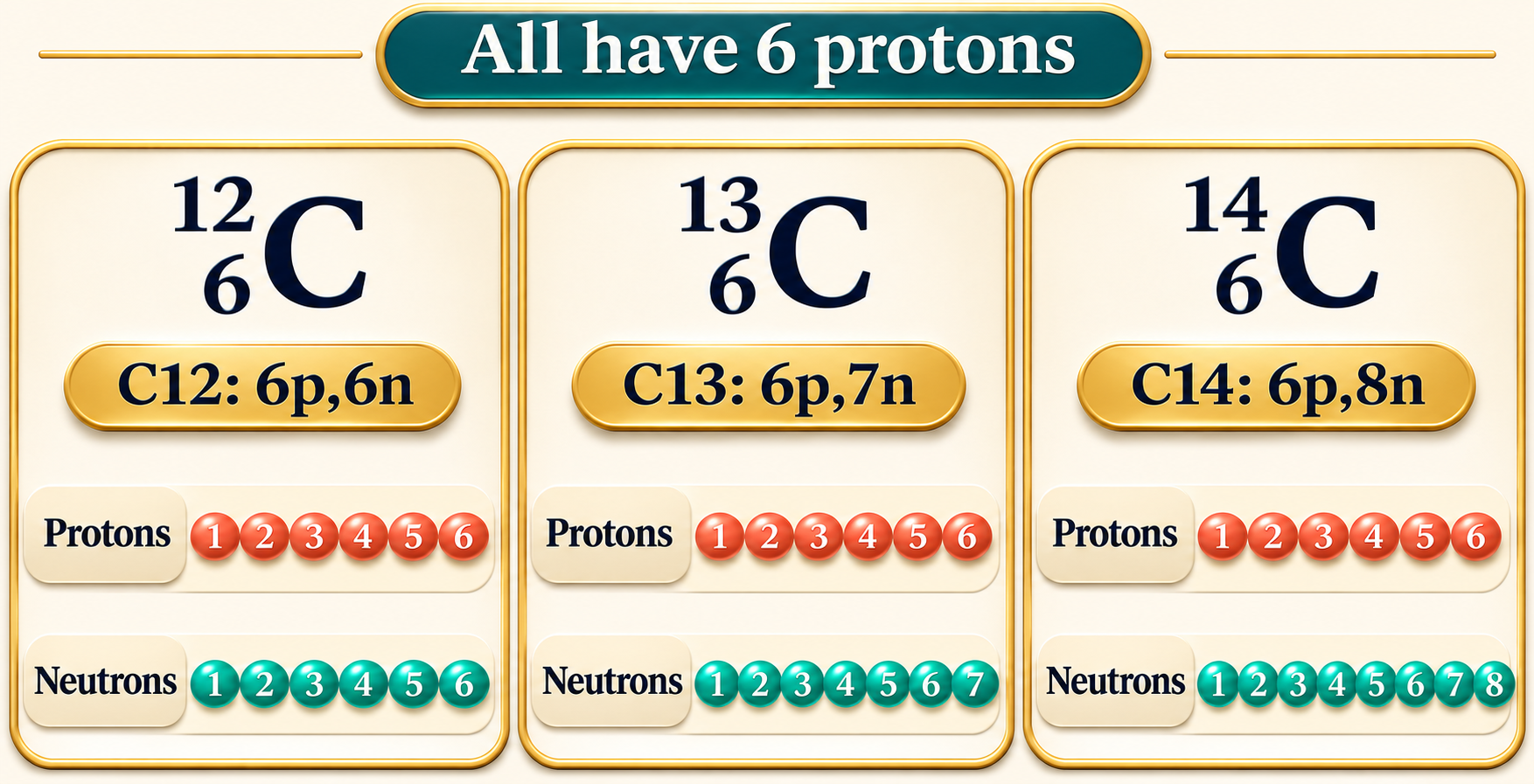
Teaching illustration
All have six protons
Carbon-12, carbon-13 and carbon-14 share six protons but differ in neutron number.
Download original PNG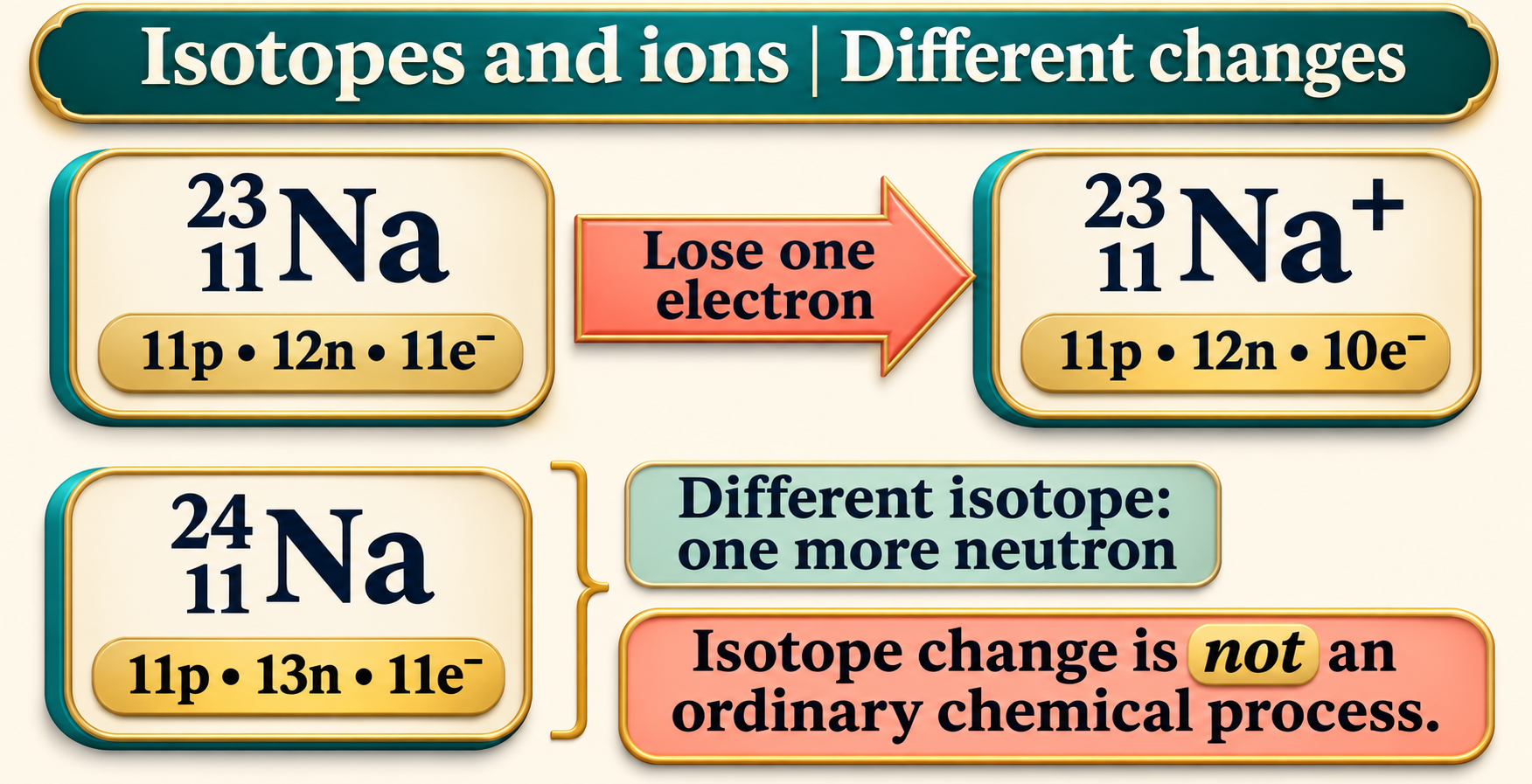
Teaching illustration
Isotopes and ions
Sodium examples distinguish losing an electron from changing the number of neutrons.
Download original PNG
Teaching illustration
Mass number versus relative atomic mass
A whole-number nuclear count is contrasted with the weighted relative atomic mass of an element.
Download original PNG
Teaching illustration
Balance alpha decay
Uranium-238 alpha decay conserves total mass number and atomic number.
Download original PNGAbout these representations
Original teaching illustrations; symbolic particles and geometry are not calibrated measurements.