
London dispersion comes from correlated fluctuations in electron clouds. These views connect temporary dipoles with polarizability and molecular shape.
Choose from five images below. Open an image for a closer look, download its original PNG, or download all five as a ZIP.
Use these visuals in your lesson
Compare argon with the helium–xenon example, then ask students to explain the pentane shapes.
A question to discuss
Why can two nonpolar molecules still attract each other?
London dispersion forces: five teaching visuals

Temporary dipoles in argon
Temporary dipoles in argon
Two argon clouds show instantaneous and induced partial charges with an attraction between unlike ends.
Download original PNG
Fluctuating electron clouds
Fluctuating electron clouds
Three panels contrast an average symmetric argon cloud with two snapshots of correlated temporary dipoles.
Download original PNG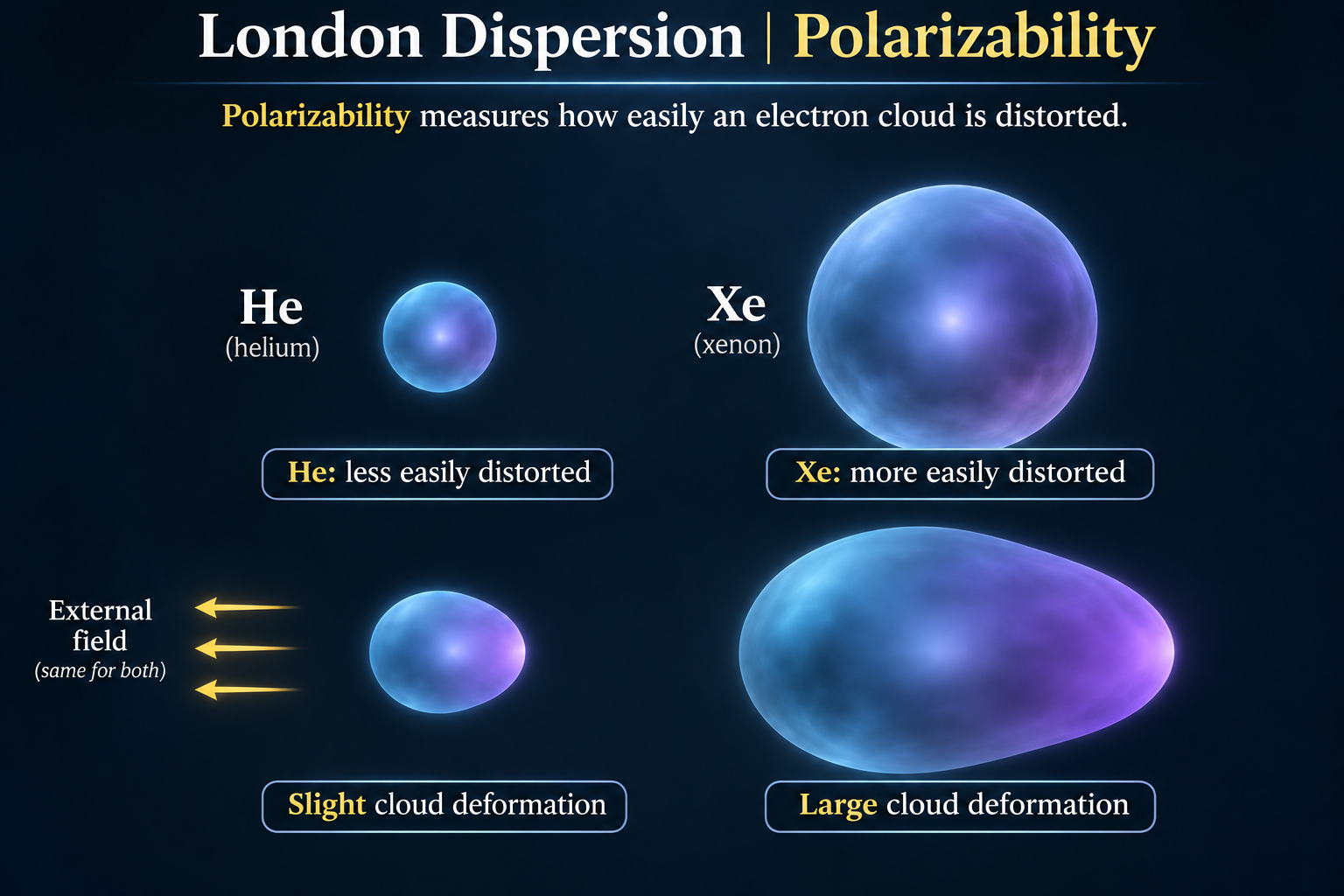
Polarizability: helium and xenon
Polarizability: helium and xenon
Helium and xenon clouds respond differently to the same external field, illustrating ease of distortion.
Download original PNG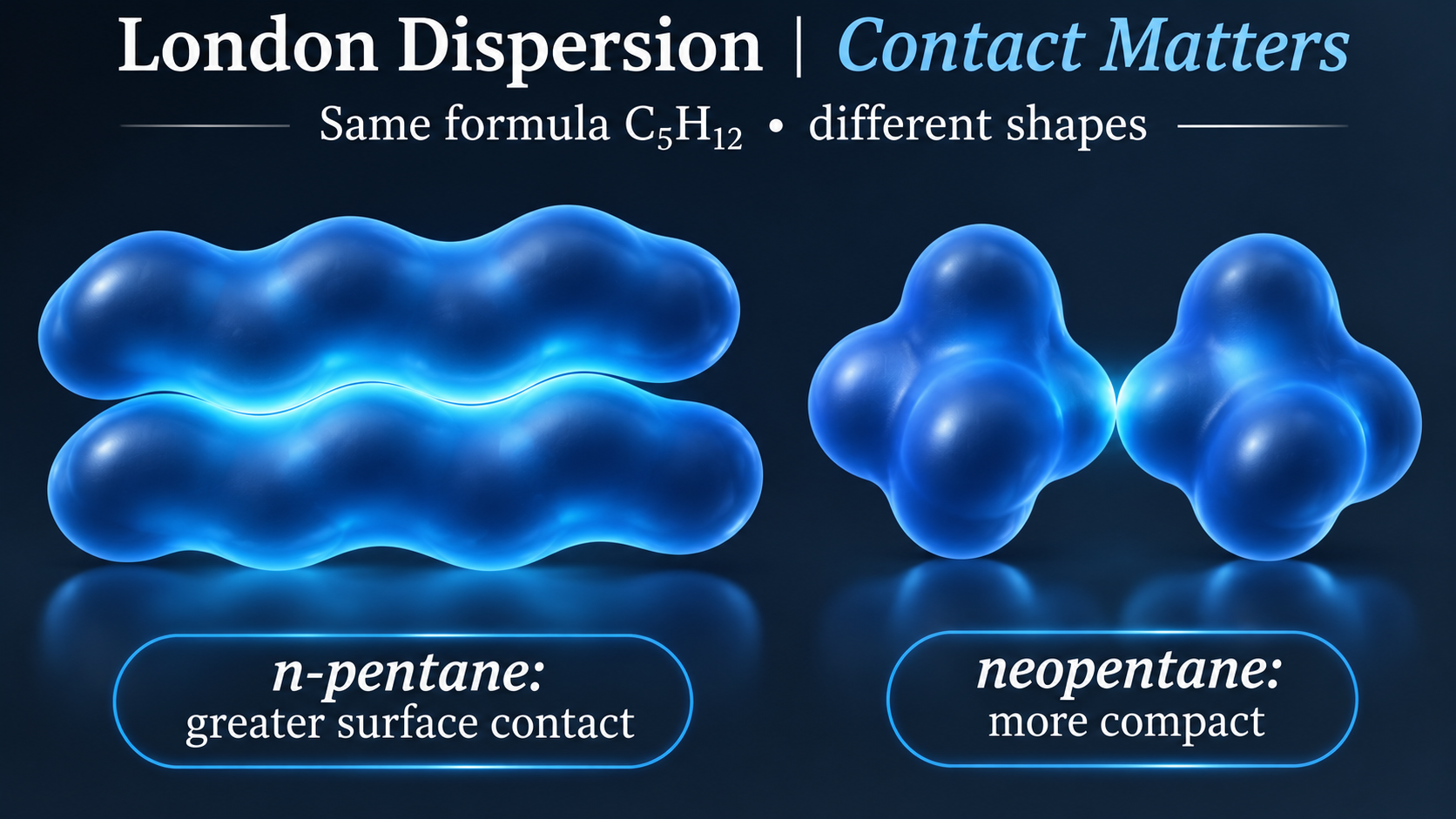
Molecular shape and contact
Molecular shape and contact
Qualitative envelopes compare greater contact between elongated n-pentane molecules with compact neopentane.
Download original PNG
A molecular view of dispersion
A molecular view of dispersion
An isolated argon average is compared with two correlated, distorted clouds and their attraction.
Download original PNGAbout these representations
Qualitative electron-cloud and molecular-envelope illustrations, not calculated electron density.