
Metallic bonding links positive ion cores with delocalised electrons. The set connects that model with conduction, malleability and alloy strengthening.
Choose from five images below. Open an image for a closer look, download its original PNG, or download all five as a ZIP.
Use these visuals in your lesson
Ask students to use one bonding model to explain both conduction and the ability of layers to slide.
A question to discuss
Why can adding a different element make a metal harder?
Metallic bonding and alloy structure: five teaching visuals
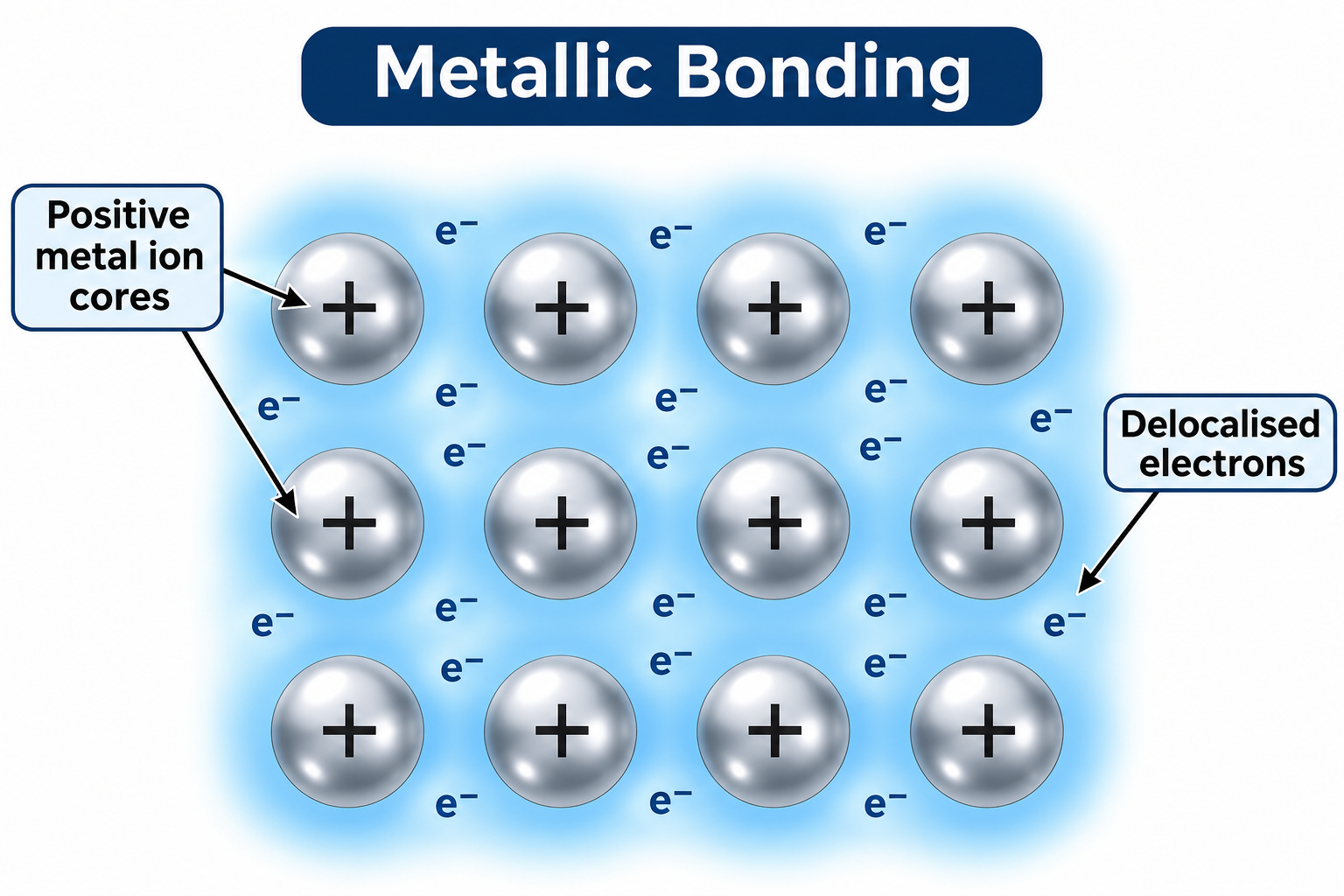
The metallic bonding model
The metallic bonding model
Positive metal ion cores sit within a shared region of delocalised electrons.
Download original PNG
Electron drift and electric field
Electron drift and electric field
Opposite arrows show electron drift against the external electric field through fixed positive cores.
Download original PNG
Sliding metal layers
Sliding metal layers
Before-and-after lattice views illustrate layer slip while attraction to delocalised electrons remains.
Download original PNG
Substitutional and interstitial alloys
Substitutional and interstitial alloys
Three lattice views compare a pure metal, replacement atoms and small atoms occupying gaps.
Download original PNG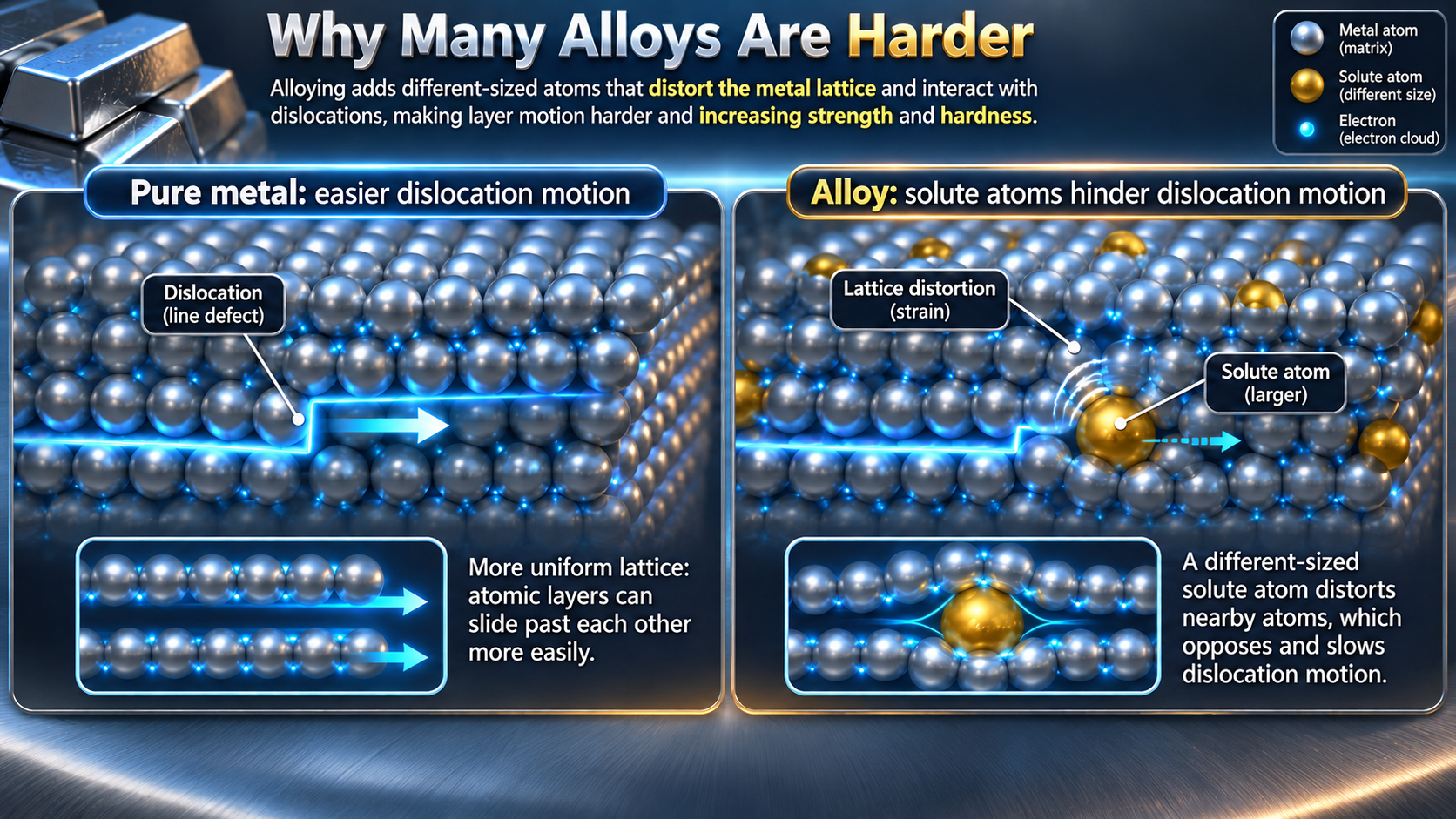
Alloys hinder dislocation motion
Alloys hinder dislocation motion
Qualitative lattice views show different-sized solute atoms disturbing the lattice and hindering dislocations.
Download original PNGAbout these representations
Qualitative electron-sea, lattice and dislocation models; rods in lattice diagrams are guides, not localised covalent bonds.