
Connect amount in moles with specified entities, molar mass and sample mass.
Choose from five images below. Open an image for a closer look, download its original PNG, or download all five as a ZIP.
Use these visuals in your lesson
Ask students to name the entity being counted before choosing N = nNA or m = nM.
A question to discuss
How can one mole of copper and one mole of water contain equal entity counts but have different masses?
The mole: equal numbers, different masses: five teaching visuals
Teaching illustration
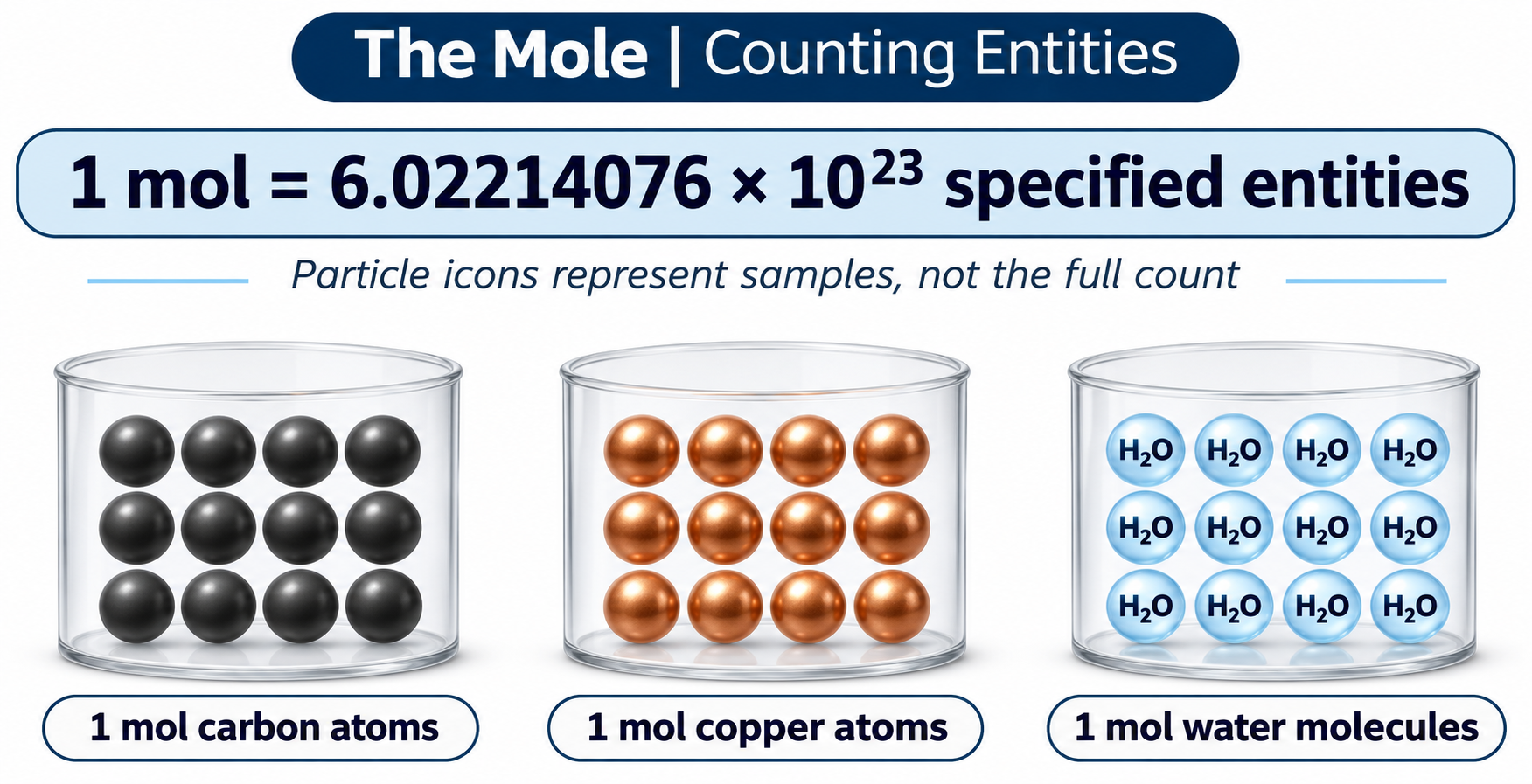
Counting specified entities
One mole of carbon atoms, copper atoms and water molecules represents the same specified-entity count.
Download original PNG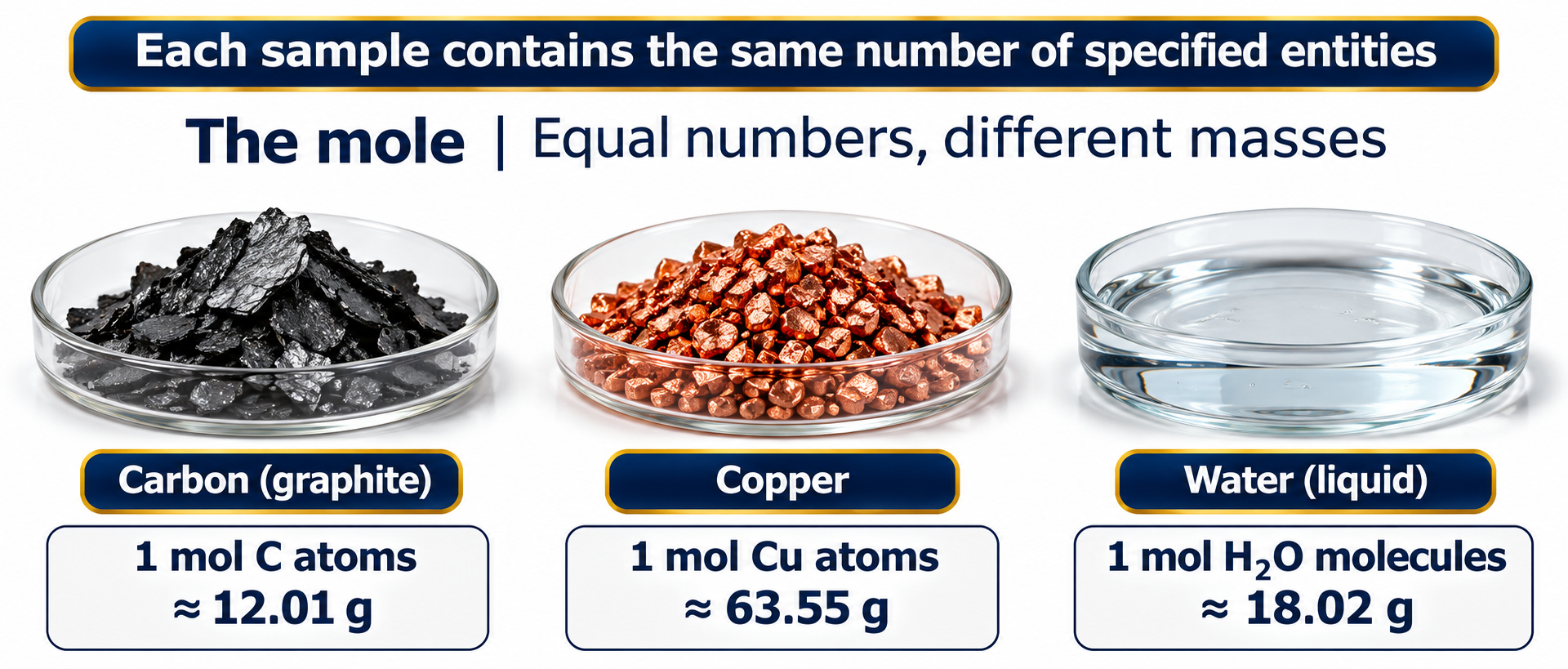
Teaching illustration
Equal counts, different masses
Graphite, copper and water samples compare approximate masses for one mole of their specified entities.
Download original PNG
Teaching illustration
Two useful relationships
A relationship map connects number of entities, amount in moles and mass.
Download original PNG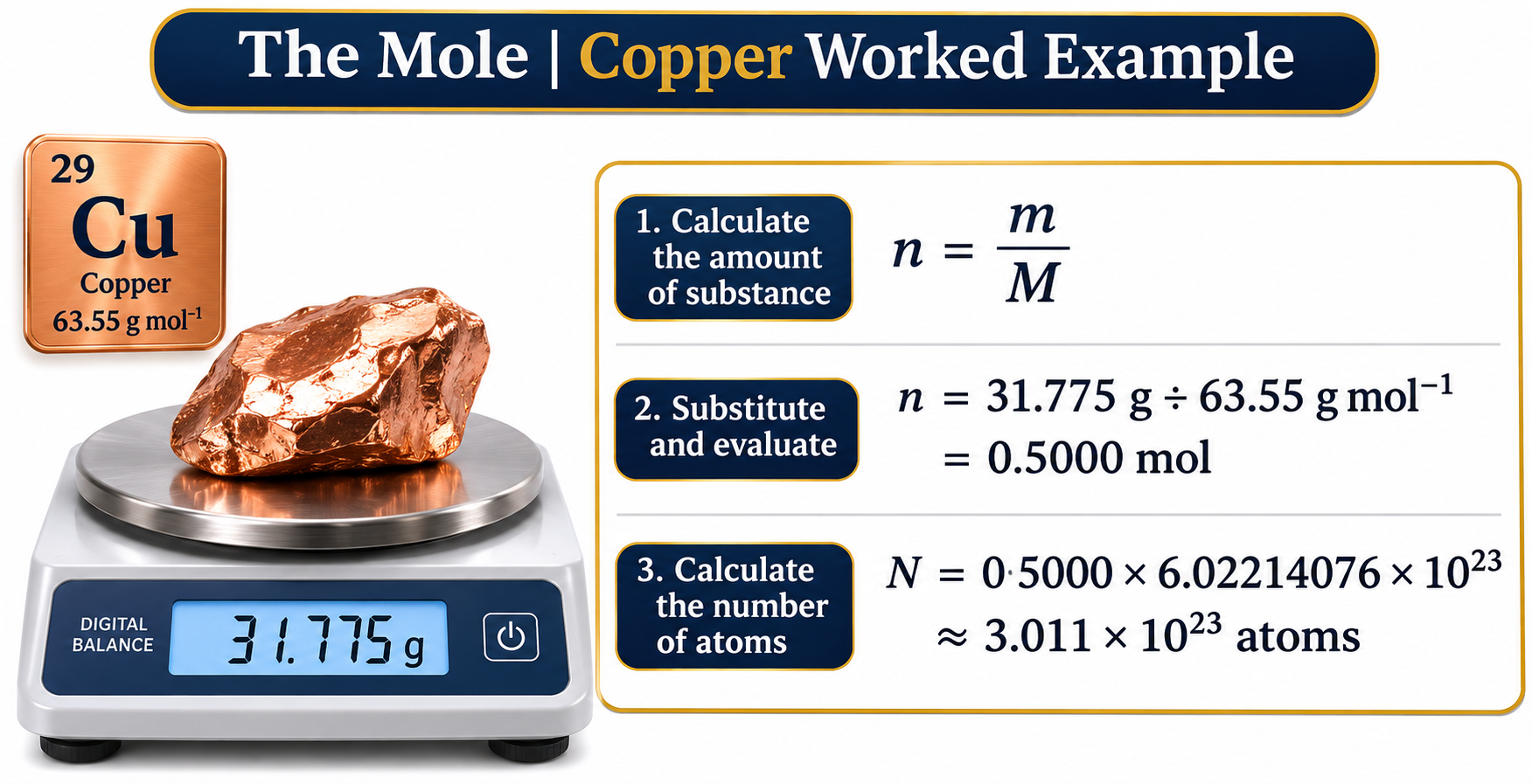
Teaching illustration
A copper calculation
A worked example converts 31.775 g of copper to 0.5000 mol and an atom count.
Download original PNG
Teaching illustration
Scaling a sample
Copper amounts of 0.25, 0.50 and 1.00 mol show mass and atom number scaling together.
Download original PNGAbout these representations
The Avogadro constant is exact; sample masses and calculated outputs are rounded teaching examples. Particle icons stand for samples, not complete counts.