
Distinguish a polar bond from a polar molecule by combining bond dipoles in three dimensions.
Choose from five images below. Open an image for a closer look, download its original PNG, or download all five as a ZIP.
Use these visuals in your lesson
Ask students to add dipole arrows rather than deciding from the presence of polar bonds alone.
A question to discuss
Why is carbon dioxide nonpolar while water is polar?
Bond polarity versus molecular polarity: five teaching visuals

Idealised model
Where electron density is drawn
O–H and H–H bonds compare unequal and equal electron sharing.
Download original PNG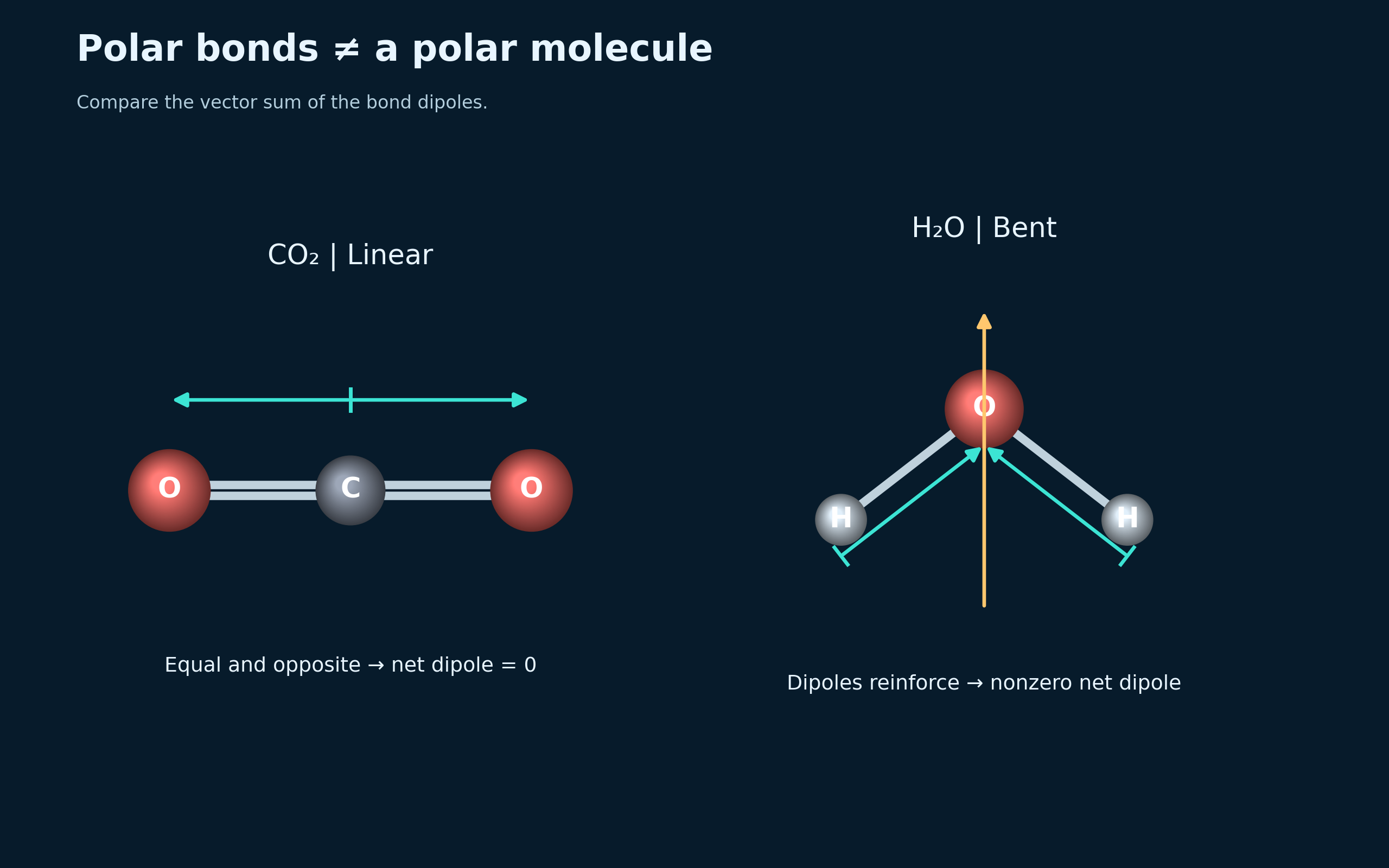
Idealised model
Polar bonds need not make a polar molecule
Opposing carbon dioxide dipoles cancel, while water has a nonzero resultant dipole.
Download original PNG
Idealised model
Add the vectors
A water model and vector construction show cancelling sideways components and a resultant toward oxygen.
Download original PNG
Idealised model
One substitution changes the sum
Tetrahedral carbon tetrachloride and chloroform compare symmetric and asymmetric bond arrangements.
Download original PNG
Idealised model
Two questions about polarity
Carbon dioxide and water summarise the need to consider both bond polarity and molecular shape.
Download original PNGAbout these representations
Idealised molecular connectivity and dipole-vector models, not measured dipole magnitudes; crossed arrow tails indicate positive ends.