
A standard solution needs a known amount of solute in a known final volume. These images focus on quantitative transfer, the calibration mark and mixing.
Choose from five images below. Open an image for a closer look, download its original PNG, or download all five as a ZIP.
Use these visuals in your lesson
Use the sequence to ask where solute could be lost and why every rinsing belongs in the flask.
A question to discuss
Why does adding water to the mark not mean adding that volume of water?
Making a standard solution: five teaching visuals
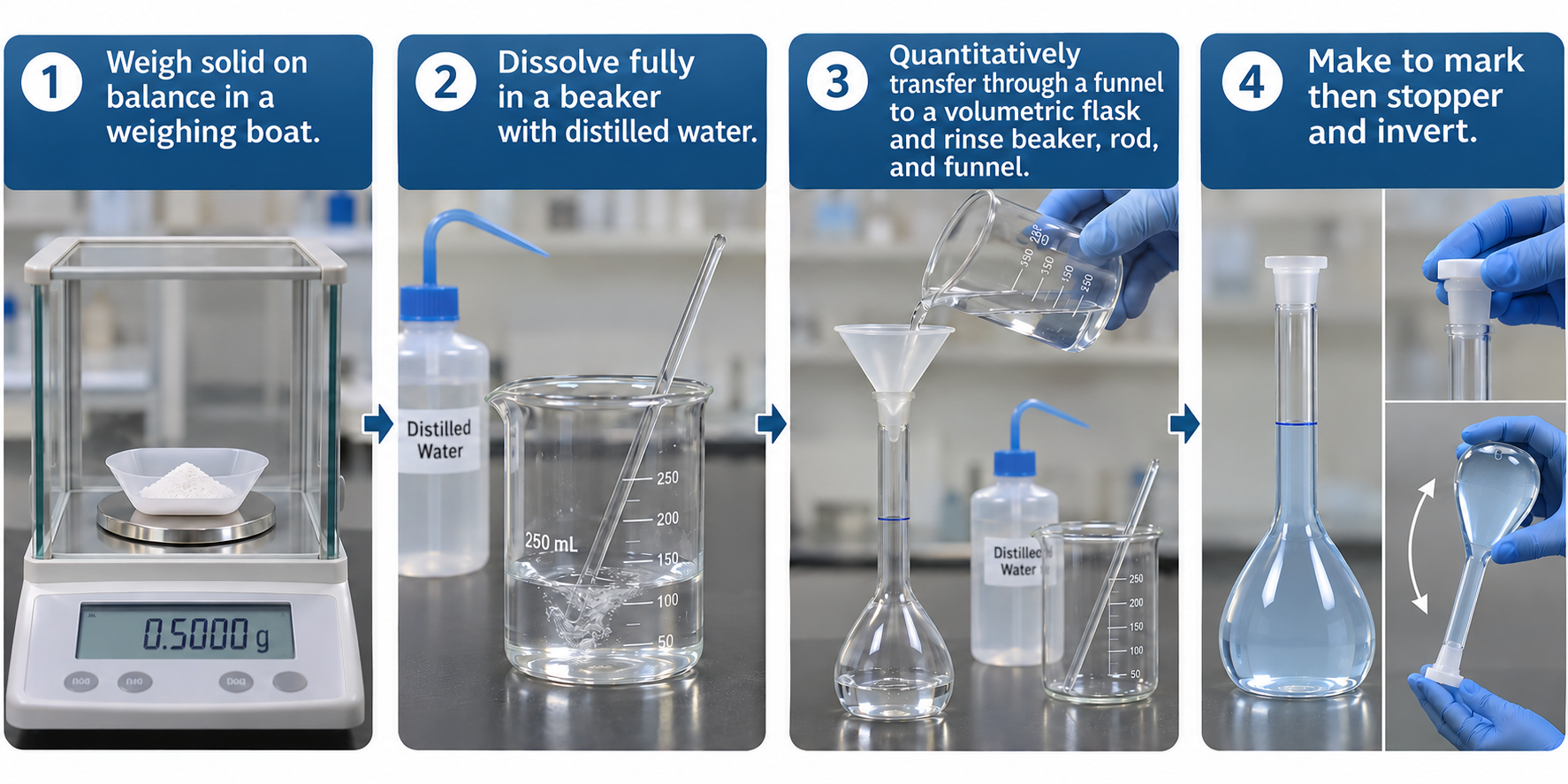
Preparing a standard solution
Preparing a standard solution
Four stages show weighing, dissolving, transferring and making up to the calibration mark.
Download original PNG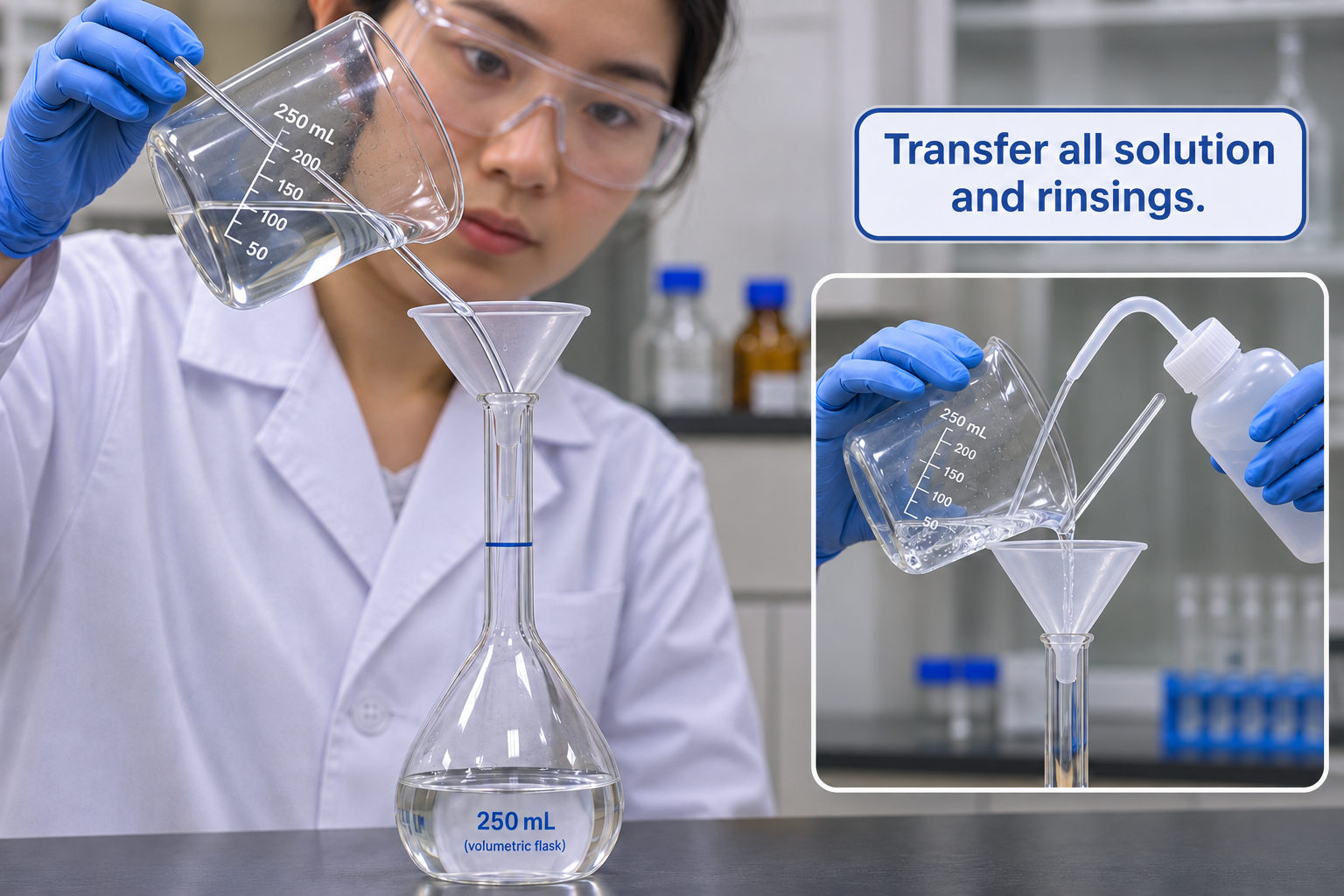
Quantitative transfer and rinsing
Quantitative transfer and rinsing
A beaker, glass rod and funnel guide solution into a volumetric flask; an inset shows rinsing.
Download original PNG
Reading the meniscus
Reading the meniscus
An eye-level view aligns the bottom of a concave meniscus with the flask mark; an inset shows dropwise addition.
Download original PNG
Sodium carbonate worked example
Sodium carbonate worked example
Preparing 250.0 mL of 0.1000 mol per litre solution requires 2.650 g of anhydrous sodium carbonate.
Download original PNG
Mixing by inversion
Mixing by inversion
A stoppered volumetric flask is inverted repeatedly to mix the prepared solution.
Download original PNGAbout these representations
Illustrative apparatus and volumetric technique; the sodium carbonate calculation uses M = 105.99 g mol−1.