
A heterogeneous catalyst offers a surface where reactants can adsorb and react. Desorption releases products and leaves sites available again.
Choose from five images below. Open an image for a closer look, download its original PNG, or download all five as a ZIP.
Use these visuals in your lesson
Trace adsorption, surface reaction and desorption, then use the cube comparison to discuss accessible surface area.
A question to discuss
Why can breaking a catalyst into smaller pieces increase its accessible area?
Heterogeneous catalysis: five teaching visuals

Reactants adsorb on a surface
Reactants adsorb on a surface
Generic A2 and B2 reactants approach and bind to a catalyst surface.
Download original PNG
Three stages of surface catalysis
Three stages of surface catalysis
Adsorption, surface reaction and desorption illustrate the generic equation A2 + B2 → 2AB.
Download original PNG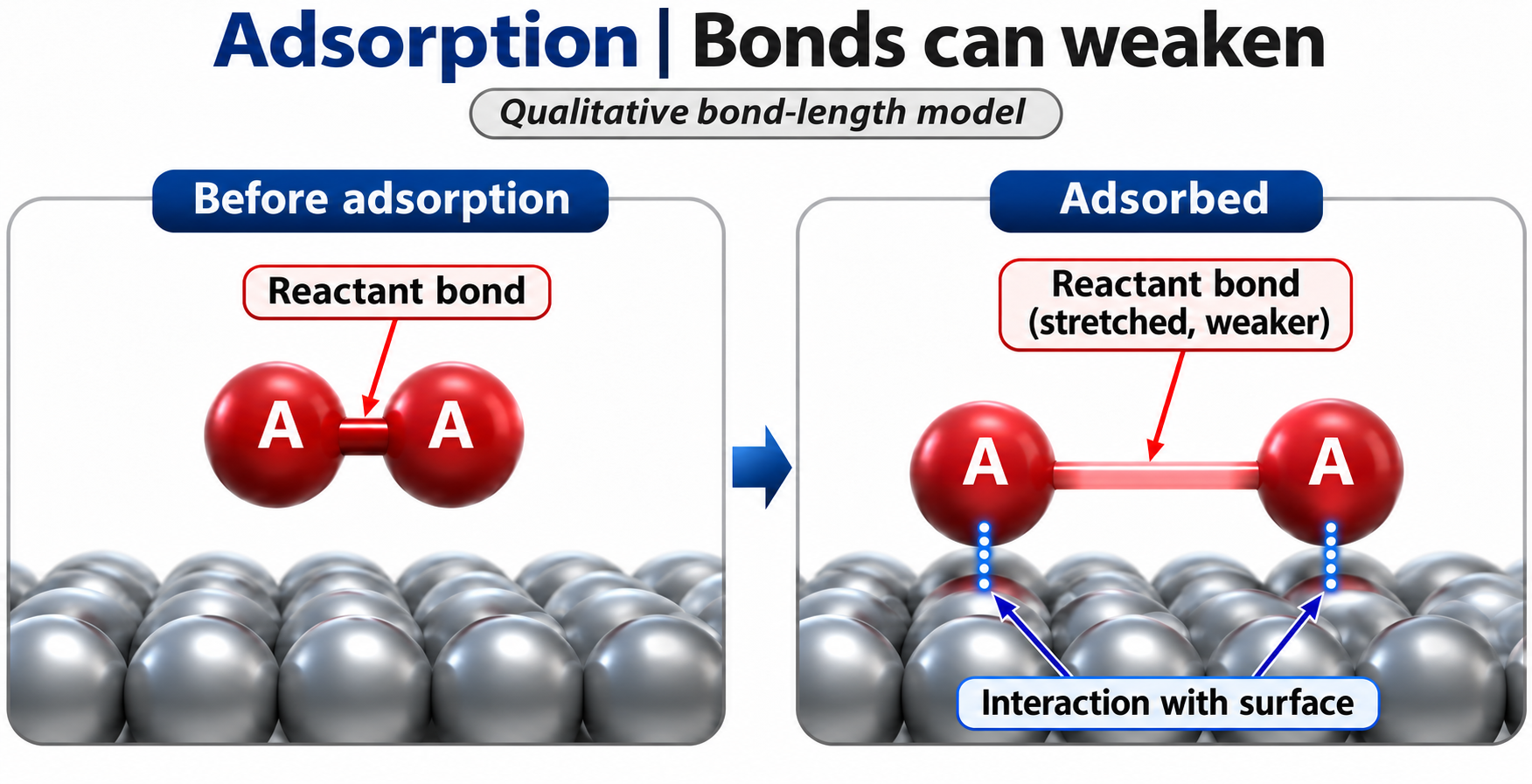
Adsorption can weaken bonds
Adsorption can weaken bonds
A qualitative model compares a reactant bond before and after interaction with the surface.
Download original PNG
Desorption frees catalytic sites
Desorption frees catalytic sites
A surface-bound AB product leaves, making sites available again.
Download original PNG
Equal volume, greater surface area
Equal volume, greater surface area
One nonporous cube is compared with eight separated half-side cubes, doubling total surface area.
Download original PNGAbout these representations
Generic surface-reaction model and separated nonporous cube geometry, not a specified catalyst crystal.