
Use interconnected feeding relationships to move beyond a single food chain. These visuals support discussion of energy transfer and the effects of changes within a community.
Choose from five images below. Open an image for a closer look, download its original PNG, or download all five as a ZIP.
Use these visuals in your lesson
Agree what an arrow represents before tracing a pathway. Ask students to propose more than one possible consequence of removing a species, rather than assuming one inevitable outcome.
A question to discuss
Why can a change in one population affect several others in a food web?
Food webs: five teaching visuals

Meadow connections
Arrows run from food to consumer in two connected examples of meadow feeding relationships.
Download original PNG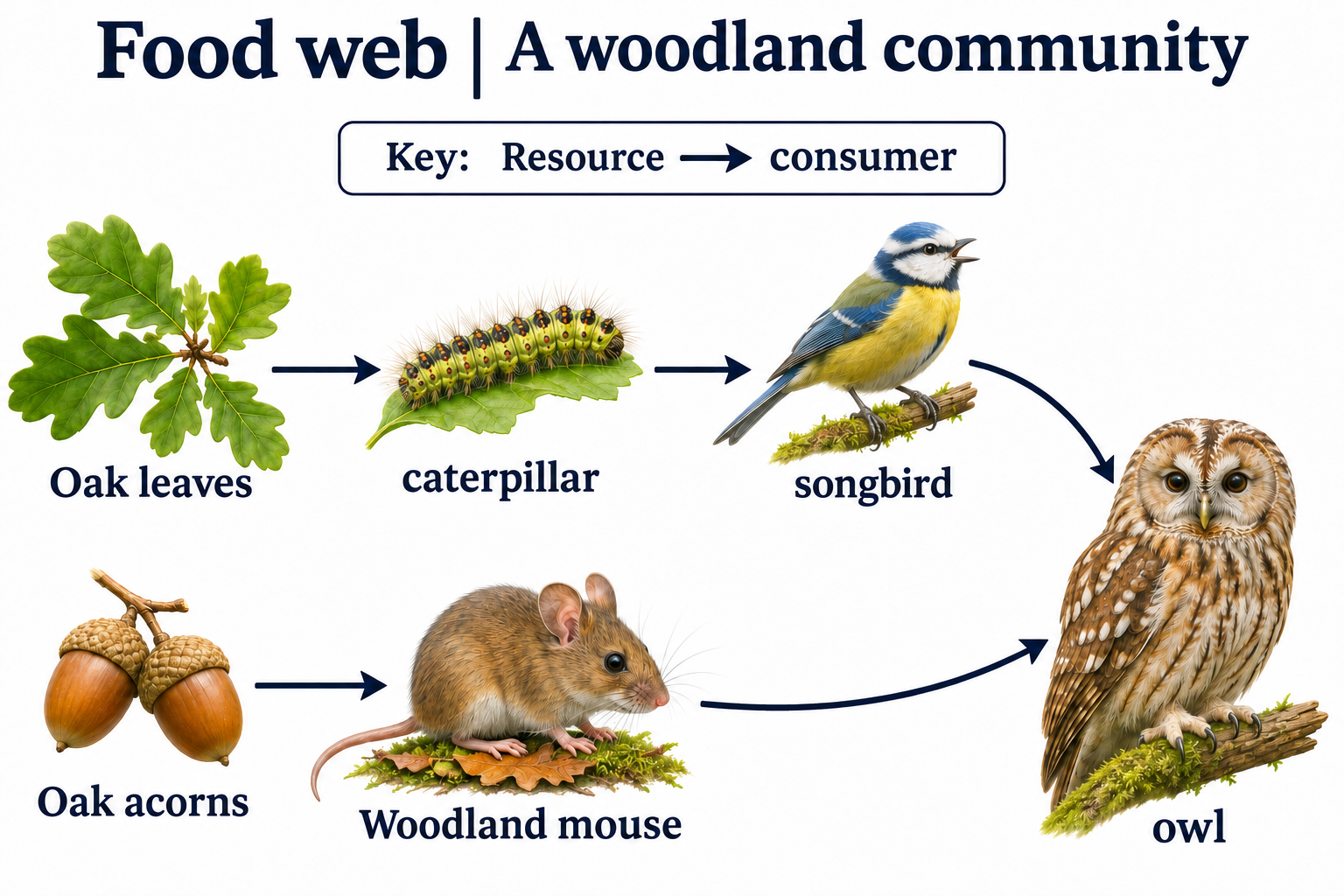
A woodland community
Oak leaves and acorns support consumers and predators in a simplified woodland web.
Download original PNG
An omnivore has two roles
A blackbird feeding on berries and caterpillars occupies different trophic roles.
Download original PNG
Removing a predator
A simplified example predicts possible rabbit increases and grass decreases after fox removal.
Download original PNG
Decomposers receive material
Dead material and waste pass to decomposers, with mineral nutrients returned to plants.
Download original PNG