Follow the breakdown of dietary proteins into smaller products that can be absorbed. The collection supports discussion of enzyme action and the changing conditions along the digestive tract.
Choose from five images below. Open an image for a closer look, download its original PNG, or download all five as a ZIP.
Use these visuals in your lesson
Ask students to distinguish digestion from absorption. Connect each enzyme example with its substrate and location rather than treating all digestive enzymes as interchangeable.
A question to discuss
Why must large dietary proteins be broken down before their components can be absorbed?
Protein digestion: five teaching visuals

Chains to building blocks
Endopeptidases and exopeptidases break proteins into smaller peptides and amino acids.
Download original PNG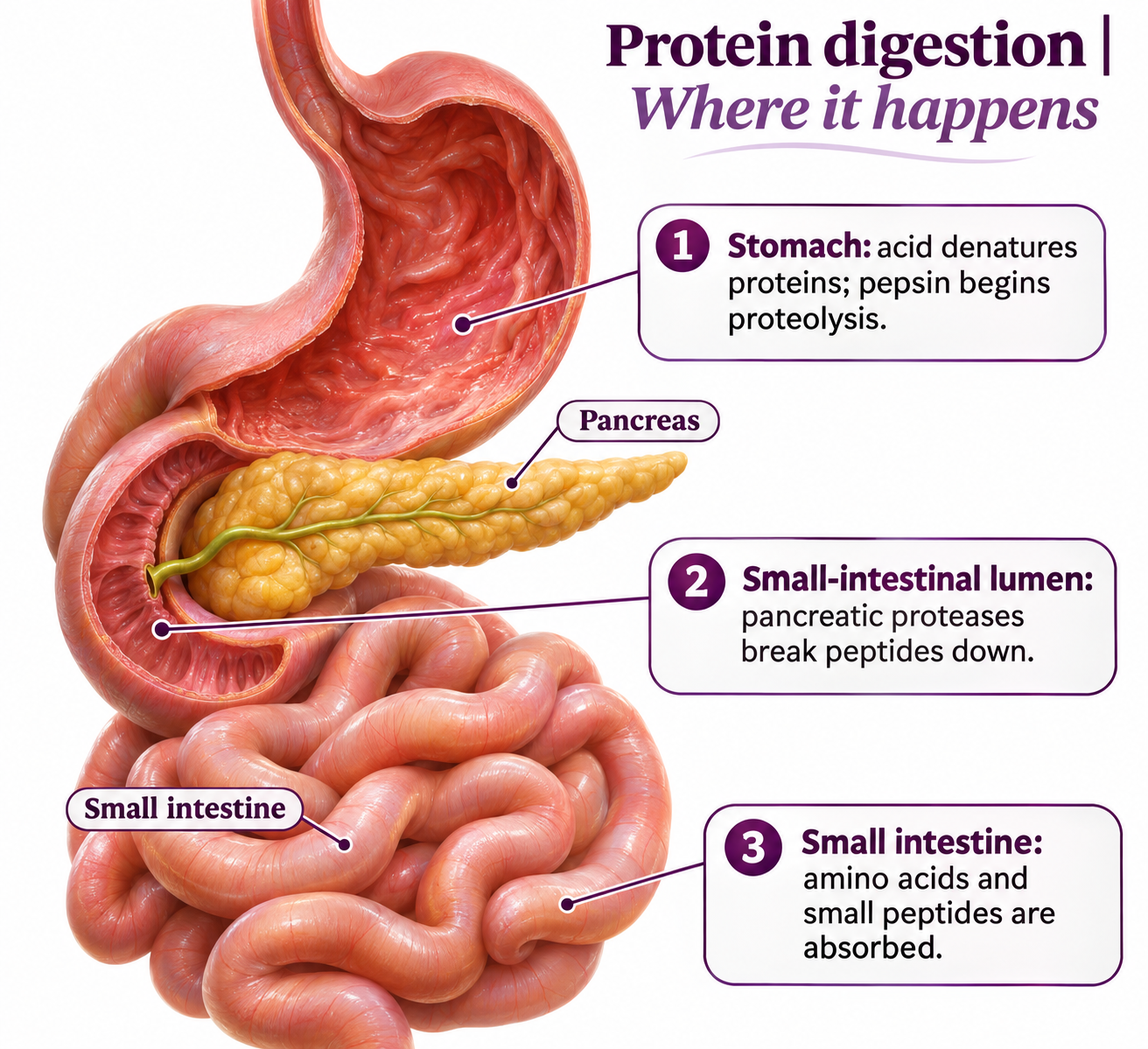
Where digestion happens
A digestive-system view locates protein digestion in the stomach and small intestine.
Download original PNG
Activating pancreatic proteases
A simplified pathway shows enteropeptidase activating trypsin and trypsin activating other pancreatic zymogens.
Download original PNG
Through the intestinal cell
Simplified transport routes show amino-acid and small-peptide absorption into an enterocyte and onward to blood.
Download original PNG
Breaking one peptide bond
A hydrolysis reaction shows water splitting a peptide bond, using neutral chemical forms for clarity.
Download original PNG