
Connect water loss from leaves with the movement of water through a plant. The images support discussion of evaporation, diffusion and the continuous water pathway.
Choose from five images below. Open an image for a closer look, download its original PNG, or download all five as a ZIP.
Use these visuals in your lesson
Trace water from the soil to the atmosphere. Ask students to identify where a phase change occurs and where water remains liquid.
A question to discuss
How does evaporation from leaf surfaces contribute to water movement through xylem?
Transpiration: five teaching visuals
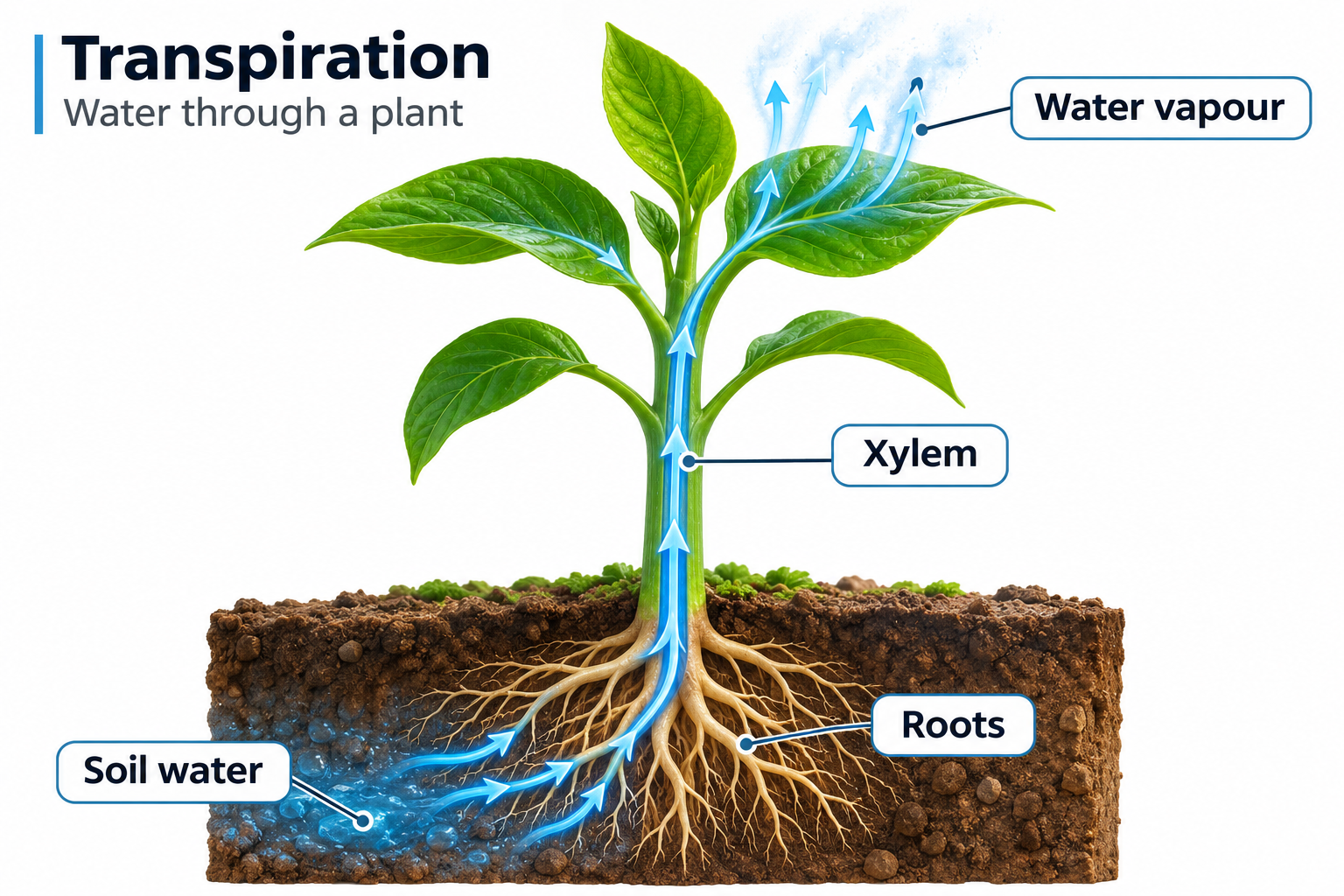
Water through a plant
Water moves from soil through roots and xylem before leaving leaves as water vapour.
Download original PNG
From root to leaf
Enlarged root-hair and xylem views connect water uptake with transport through the plant.
Download original PNG
Evaporation then diffusion
Water evaporates from wet mesophyll cell walls and vapour diffuses through stomatal pores.
Download original PNG
Cohesion and tension
Evaporation creates tension while cohesion helps maintain a continuous water column in xylem.
Download original PNG
Humidity and water loss
At equal temperature, airflow and stomatal opening, drier air produces a steeper water-vapour gradient.
Download original PNG